



Infinity pools and wellbeing: Why do we feel better by the water?
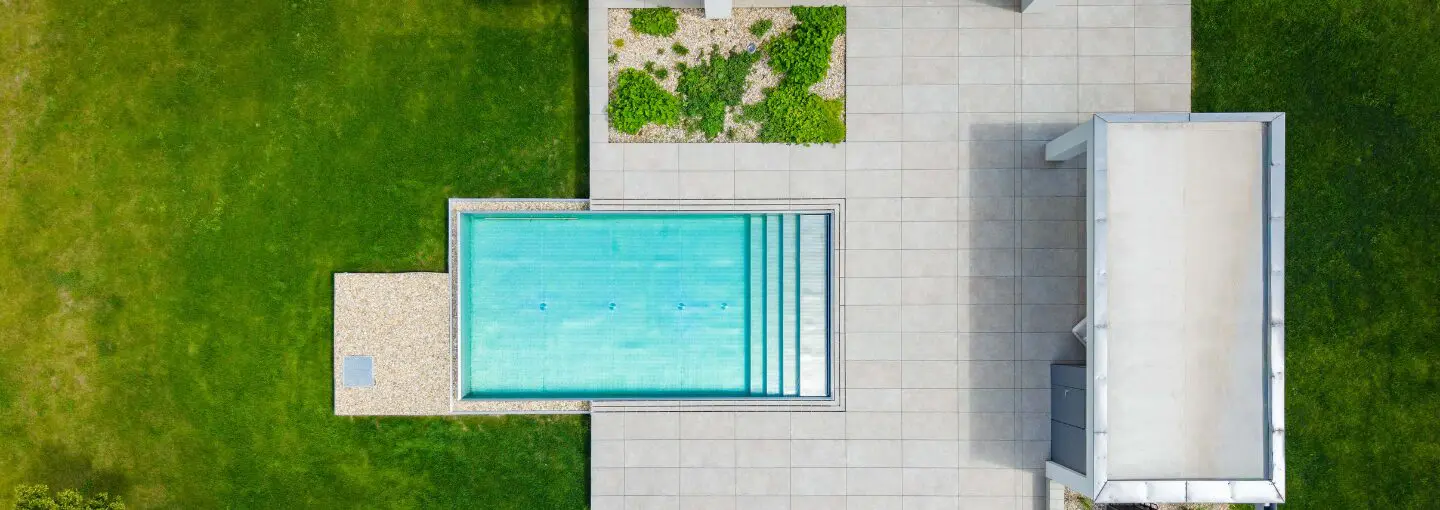
There is a tangible reason why people are willing to pay significantly more for a hotel room with a sea view than for an identical room with a view of the hinterland or courtyard. Why architects place pools in the most exposed areas of terraces and why photographs of an infinity pool – a pool with an infinite edge – merging with the horizon evoke an immediate and deep emotional response. This reaction is neither accidental nor culturally conditioned; it is deeply biological, neurologically documented and described in terms of environmental psychology. Water has a completely different effect on the human psyche than any other environment, and an infinity pool, as an architectural element, maximises this effect thanks to its design.
Blue Mind: The science of why water calms us
The cornerstone of the modern understanding of the relationship between water and the human psyche is the concept of the “Blue Mind”, popularised by American marine biologist Wallace J. Nichols in his 2014 book of the same name. Nichols gathered decades of research from neuroscience and environmental psychology to define the specific state of consciousness that water evokes.
The Blue Mind is a slightly meditative, calm and creative state of consciousness. It is characterised by reduced activity of the amygdala (the centre of stress and fear in the brain) and increased levels of neurotransmitters such as serotonin and dopamine. This state is the opposite of the so-called “Red Mind” – a hyperactive, overloaded and chronically stressed state in which most modern people spend their working days under a barrage of notifications, emails and multitasking. The brain in “red mind” mode produces cortisol and adrenaline, which leads to mental fatigue and burnout. In this context, the transition from a red to a blue mind is not a luxury, but a physiological necessity for the regeneration of the body.

Neurology of the blue space
What exactly happens in our brain when we look at the water surface or immerse ourselves in it? Research using functional magnetic resonance imaging (fMRI) has yielded specific data.
Activation of the Default Mode Network (DMN)
Being by the water activates the so-called Default Mode Network. It is the part of the brain that switches on when we are not focused on a specific external task – when our mind wanders freely. This network is crucial for introspection, processing emotions and creativity. By the water, the brain stops analytically processing the environment and switches to free association mode.
A chemical cocktail of happiness
Physical activity in water and the very presence of the aquatic environment trigger the release of beneficial chemicals:
- Endorphins: Natural pain relievers and happiness inducers, also known as “swimmer’s high”.
- Serotonin: A neurotransmitter associated with a stable mood and a sense of well-being, the level of which increases during rhythmic movement in water.
- BDNF (Brain-Derived Neurotrophic Factor): A protein that promotes the growth and repair of neurons. John Ratey of Harvard calls it the “Miracle-Gro for the brain”. Exercise in water has been shown to increase BDNF levels, which improves memory and mood regulation.
Mammalian Dive Reflex
The moment our face touches the water, it triggers an automatic body reaction known as the mammalian diving reflex. The heart rate drops by 10 to 25%, the blood vessels in the limbs contract, and the parasympathetic nervous system is activated. The body physically switches from “fight or flight” mode to “rest and digest” mode. This mechanism is so powerful that it can physically suppress the onset of panic or anxiety.
Environmental psychology and the theory of recovery
Environmental psychology examines how the physical environment shapes us. Bodies of water, referred to as “blue spaces”, have a privileged position in this respect.
Attention Restoration Theory (ART)
According to the authors Kaplan & Kaplan (1989), the modern urban environment requires constant “focused concentration”, which exhausts us. Nature, and especially the water surface, provides stimuli that attract our attention in a non-violent way (“soft fascination”). This allows the brain to take a break from analytical work without getting bored.
Stress Reduction Theory (SRT)
Roger Ulrich (1983) postulated that humans are evolutionarily programmed to respond to certain natural environments by reducing physiological stress. For our ancestors, the sight of a vast expanse of water was a sign of abundant resources and safety from predators. This evolutionary trace has remained in us – by the water, the level of cortisol (a stress hormone) drops faster than in any artificial environment.
The infinity pool as a psychological amplifier
While a standard pool with visible edges is perceived by our visual system as bounded and enclosed, an infinity pool (a pool with an infinite edge) functions as
Visual infinity and the horizon
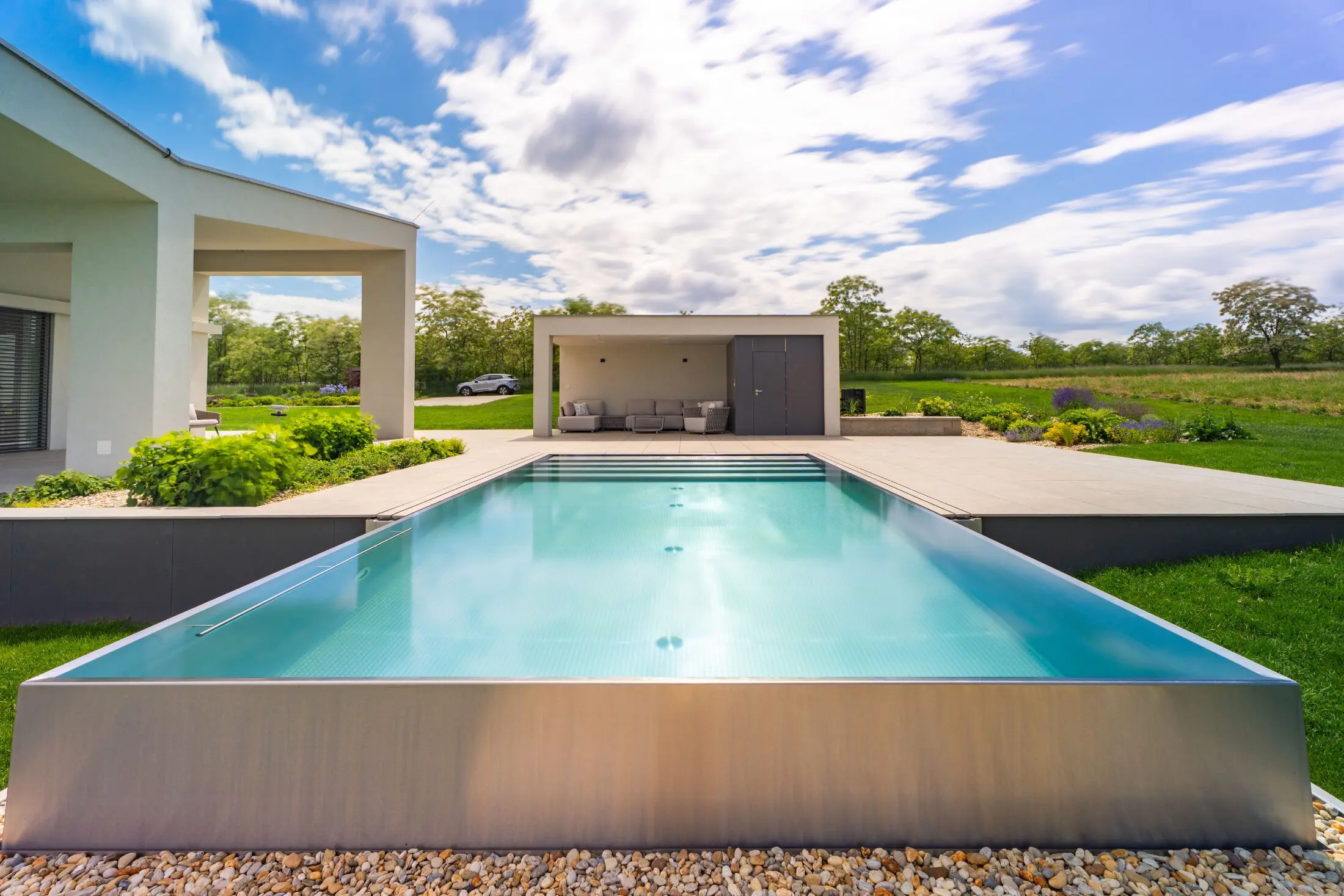
The overflow edge of the infinity pool removes the visual barrier between the water in the pool and the landscape beyond. The visual brain thus perceives openness and spaciousness, which is neurologically associated with a feeling of freedom and a reduction in anxiety. The horizon plays a key role. Evolutionarily, seeing far meant having an overview and control over space. Our brain interprets the view of the horizon as a signal of safety. The design of the infinity pool, which optically blends with the horizon, activates this archetypal pattern with maximum effectiveness.
The acoustic calm of the overflow
The sound of water affects different brain structures than images. The gentle, continuous sound of water dripping over the edge of the infinity pool activates the parasympathetic nervous system, lowers blood pressure and suppresses the areas of the brain responsible for anticipating threats. It is therefore not just an aesthetic detail, but a functional element that “calms” the alarm system of our brain.

Material and light
The choice of materials also has a psychological effect. For example, a stainless steel infinity pool uses the reflective properties of the surface to create visual depth and dynamism. Light reflections change with the time of day and the movement of the surface, providing exactly the type of complex but rhythmically predictable stimulus that relaxes the brain but does not tire it.
Concentration and mental performance
Time spent by an infinity pool is not just about relaxation, but also about investing in cognitive abilities.
- Increased creativity: A study showed that being in a natural (especially aquatic) environment improves performance in creative thinking tests by 50%. Freeing the prefrontal cortex from analytical tasks allows the brain to generate new associations and perspectives.
- Improved concentration: Research by Griffith University has confirmed that people moving in blue spaces exhibit better working memory and a higher ability to subsequently concentrate in a work environment.
- Digital detox: The pool provides a natural environment for disconnecting from screens. The absence of digital noise by the water allows the brain to reset its attention capacities, which are constantly exhausted in everyday life.
Sleep and deep recovery
The relationship between the aquatic environment and the quality of sleep is another pillar of wellbeing. The mechanism is multi-stage:
- Cortisol reduction: Being by the water lowers the level of the stress hormone, which is the main enemy of deep sleep.
- Thermoregulation: Immersion in water and subsequent cooling of the body after exiting simulates the natural drop in body temperature before sleep, which makes it easier to fall asleep.
- Circadian rhythm: Exposure to natural light by an outdoor pool helps regulate the body’s internal clock.
Research has confirmed that regular evening exposure to an aquatic environment statistically significantly prolongs the deep sleep phase and reduces the number of night-time awakenings. A guest at a resort with an infinity pool who spends the evening by the water is therefore likely to achieve better quality regeneration than one who stays indoors.
The social dimension of water
Water has a fascinating ability to reduce social anxiety. Wallace Nichols emphasises that the aquatic environment facilitates open communication and deepens emotional connections between people.
Social psychology studies show that conversations held by the water tend to be longer, more personal and exhibit fewer defence mechanisms. The mechanism is again neurological: reduced amygdala activity leads to greater openness towards others. The infinity pool here acts as a social catalyst – sharing an endless view and a shared perception of the horizon creates a space for deep social wellbeing, which is difficult to build in other parts of the resort’s architecture.

“Blue prescriptions”: Water as medicine
The impact of water on mental health is so measurable that in some countries (e.g. the United Kingdom or New Zealand) are starting to use so-called “blue prescriptions”. Doctors recommend that patients with mild anxiety or depression spend time by the water as part of their therapeutic plan.
A large-scale study by Mathew White’s team at the University of Exeter (2019) on a sample of 26,000 respondents confirmed that people living near bodies of water show significantly lower levels of anxiety and higher life satisfaction. In some cases, regular time spent by the water led to an improvement in symptoms comparable to the effect of mild medication, but without side effects.
Conclusion: The architecture of silence and presence
In the context of modern wellbeing, an infinity pool is not just a luxury accessory or an aesthetic plaything. It is a consciously designed tool for achieving the “Blue Mind” state. Its strength lies in its passive effectiveness – unlike meditation, yoga or other active relaxation techniques that require time and effort, an infinity pool works instantly and for everyone.
All you have to do is come, sit on the edge or dive in, and the neurological response will kick in on its own. The water, the horizon and the sound of the overflow will do the work for you. In today’s fast-paced world, where attention is the most valuable commodity, the infinity pool represents a unique “architecture of presence” that brings us back to ourselves and to the basic biological signals of safety and calm.