A stainless steel rooftop swimming pool: why metal is the best material when every kilogram counts
The roof is the most attractive place for a pool to be located – and also the most challenging. The view, privacy, the architectural wow factor. But also load-bearing capacity, accessibility, waterproofing, wind and the physical reality that water weighs a tonne per cubic metre and concrete weighs significantly more. Sooner or later, every developer or architect considering a rooftop pool comes to the same question: what should it be made of?
The answer, which is being adopted by an increasing number of projects in Central and Western Europe, is stainless steel. And the reasons are not just aesthetic.
Weight as the first argument
The roof structure has a load-bearing capacity. This is firmly determined by the static calculation of the building, and no wish of the investor will change it. A full pool measuring 6 × 3 × 1.4 m contains approximately 25 tonnes of water. To this is added the weight of the pool structure itself.
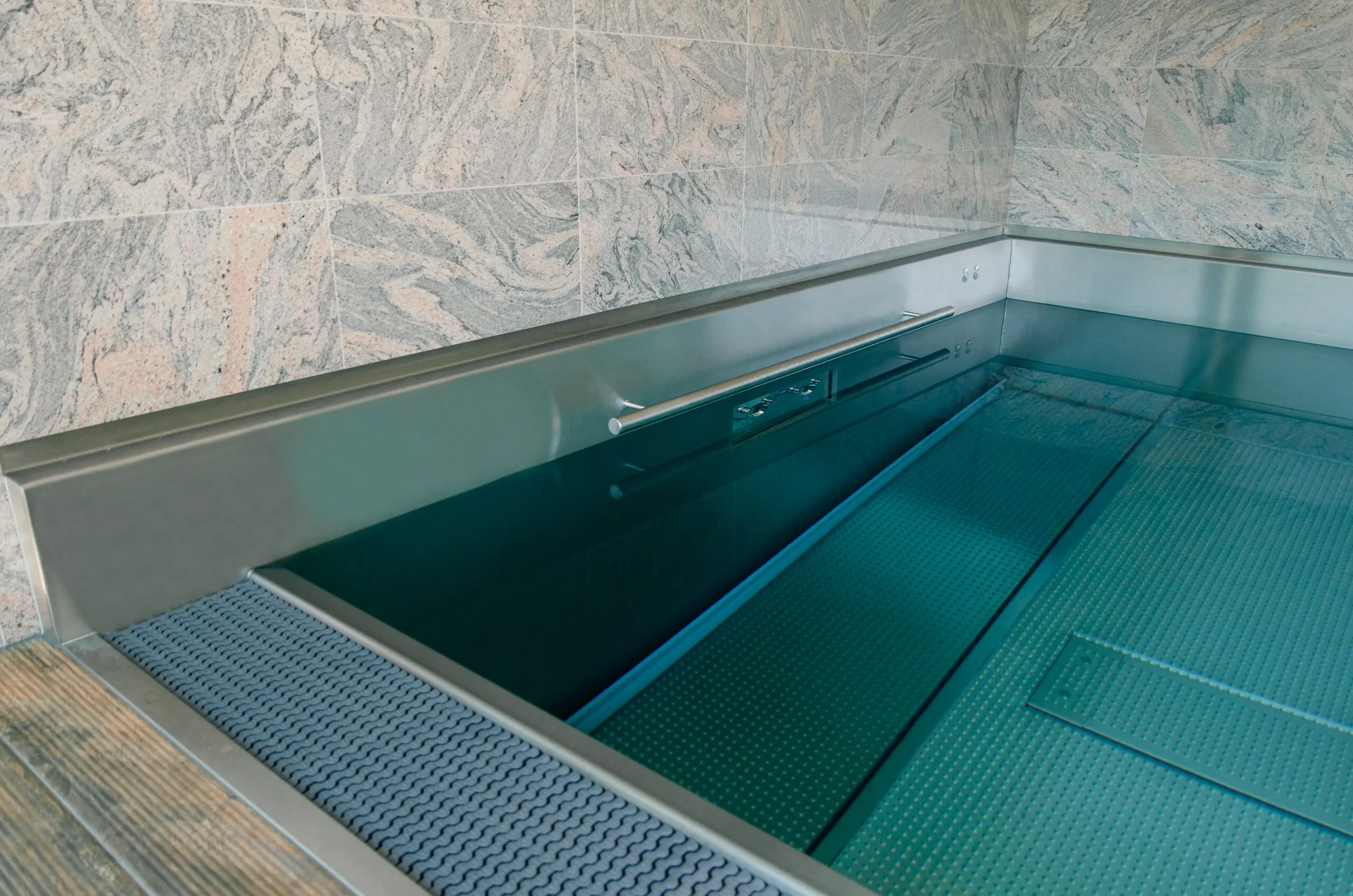
And this is where stainless steel has a clear advantage. A stainless steel pool of the same dimensions weighs around 70–80% less than a comparable concrete structure. Concrete requires massive walls, reinforcement and a base slab – the weight of the empty concrete pool itself is measured in tonnes. Stainless steel sheet with a thickness of 2.5–3 mm is a self-supporting structure with minimal dead weight.
In practice, this difference means that a rooftop pool that would not be structurally possible with a concrete structure can be built with stainless steel. Or that the same roof load-bearing capacity allows for the design of a pool with a significantly larger volume if it is made of stainless steel. This is the starting point for every rooftop project – and stainless steel comes out on top in the vast majority of cases.
Why roofs also favour stainless steel over liner and acrylic
A rooftop pool is exposed to conditions that a pool in the garden or indoors will never experience. UV radiation without natural shading, greater temperature fluctuations, and, in some locations, sea air or industrial emissions. These conditions accelerate the degradation of materials that are sensitive to UV or chemical influences.
Liner on a roof ages faster than in a garden. Acrylic or GRP gradually fades and becomes brittle under direct sunlight. Stainless steel (316L, V4A) withstands these conditions without any degradation – it is not affected by UV radiation, thermal expansion is predictable and manageable in terms of the material, and the chloride resistance of V4A is sufficient even for coastal locations.
A stainless steel rooftop pool looks the same after ten years of use as it did on the first day. This is not an advertising slogan – it is a material property that has a direct impact on the value of the property and on operating costs.

Rooftop installation: why it matters
Building a pool on a roof has one crucial logistical parameter that is very easy to overlook when choosing the material: how does the pool get up there?
A concrete pool is built directly on site – bricklaying, reinforcement, concrete pouring, curing and surface treatment all take place on the roof. Weeks of work on the roof, construction debris, moisture, dust. This is inconvenient when constructing a new building, but practically impossible in an operating hotel or apartment building.
A stainless steel pool is manufactured in a factory, delivered as a whole or in large prefabricated parts, and lifted onto the roof by crane. The entire installation takes days, not weeks. In an operating hotel, this means minimal disruption to operations. In an apartment building, this means that tenants do not have to put up with construction work for months.
Larger pools that cannot be lifted onto the roof in one piece are welded directly on site from pre-prepared parts. Our certified welders perform precision welding work in any conditions – including high roofs, narrow access routes or confined work areas. The resulting quality of the welds is identical to that achieved in the factory.
Rooftop pool for a hotel: specifics of commercial operation
In hotel operations, a rooftop pool must meet requirements that a private pool does not need to meet. Standards for public swimming pools (DIN 19643, EN 15288), strict hygiene standards, barrier-free access, resistance to intensive use.
Stainless steel meets these requirements systematically. The non-porous surface of grade 316L with a roughness of Ra ≤ 0.8 µm does not allow bacteria and algae to settle, regardless of the quality of chemical management. Unlike ceramics or concrete, no joints are formed – potential sites for biofilm. The overflow edge in stainless steel remains perfectly level to the millimetre even after ten years of intensive use, which is a prerequisite for the correct functioning of the overflow and the infinity effect.
The automation of chemical management and the pool control system can be integrated into the central control panel of the entire wellness facility. From a single location – ideally the reception – the operator can control the temperature, filtration, lighting and chemical parameters of the pool without the need to be physically present on the roof. This is the kind of operational realism that small hotels with limited staff will appreciate the most.
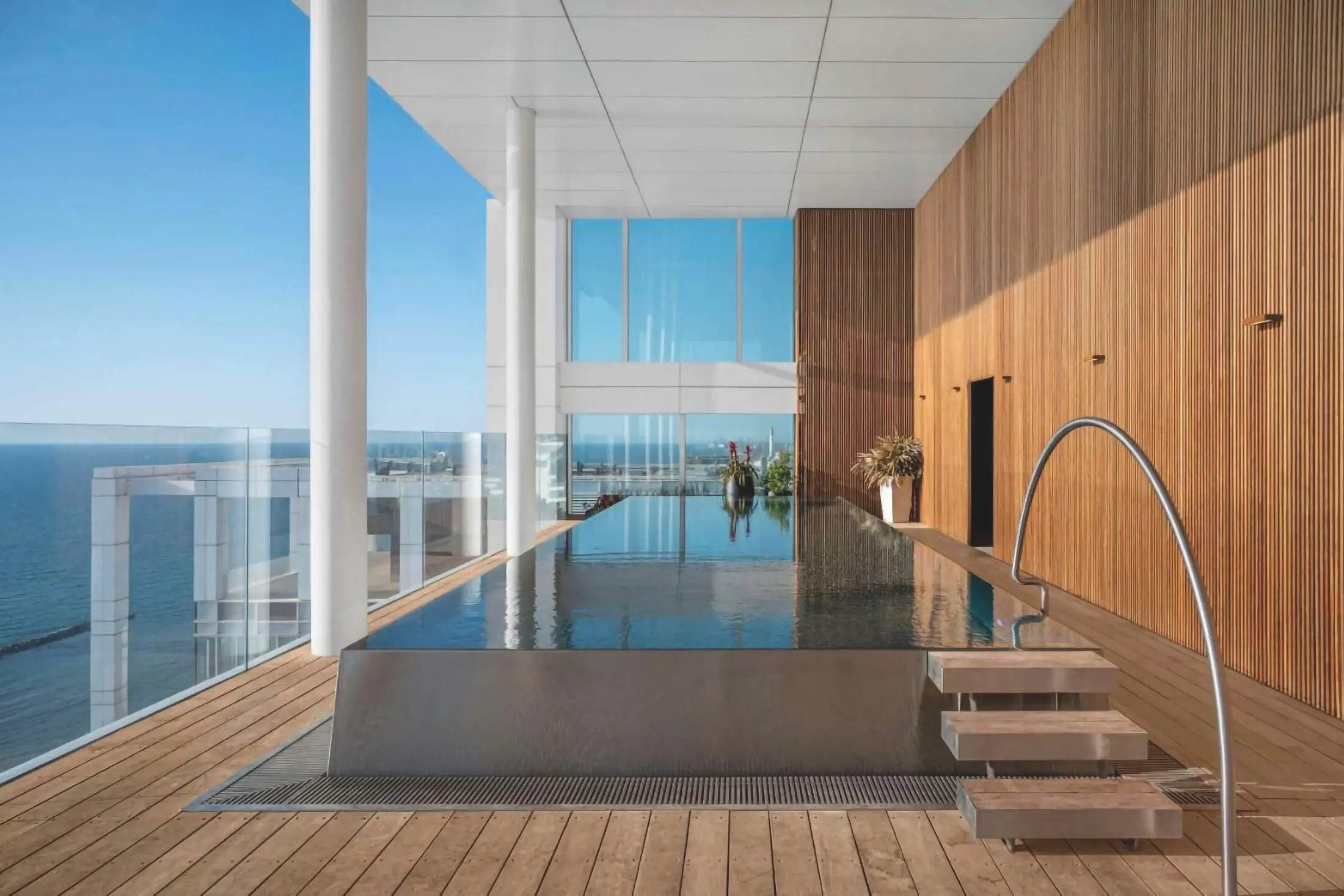
Rooftop pool for residential buildings: privacy and property value
In a residential context, a rooftop pool serves a different function than in a hotel. It is not a shared amenity – it is a private feature that determines the value and marketability of the property.
Data from the premium property market are clear in this respect: properties with a rooftop pool achieve prices 15–35% higher in premium locations than comparable properties without one. A rooftop infinity pool with a panoramic view is the strongest visual argument available to estate agents in the premium category – in online presentations, on social media and during in-person viewings.
For the developer, this means: a stainless steel rooftop pool is not a cost item, but an investment with a clearly measurable impact on the property’s sale price or rental value. The return on investment in premium residential projects tends to be faster than most developers would expect.
The infinity effect on the roof: why it works best here
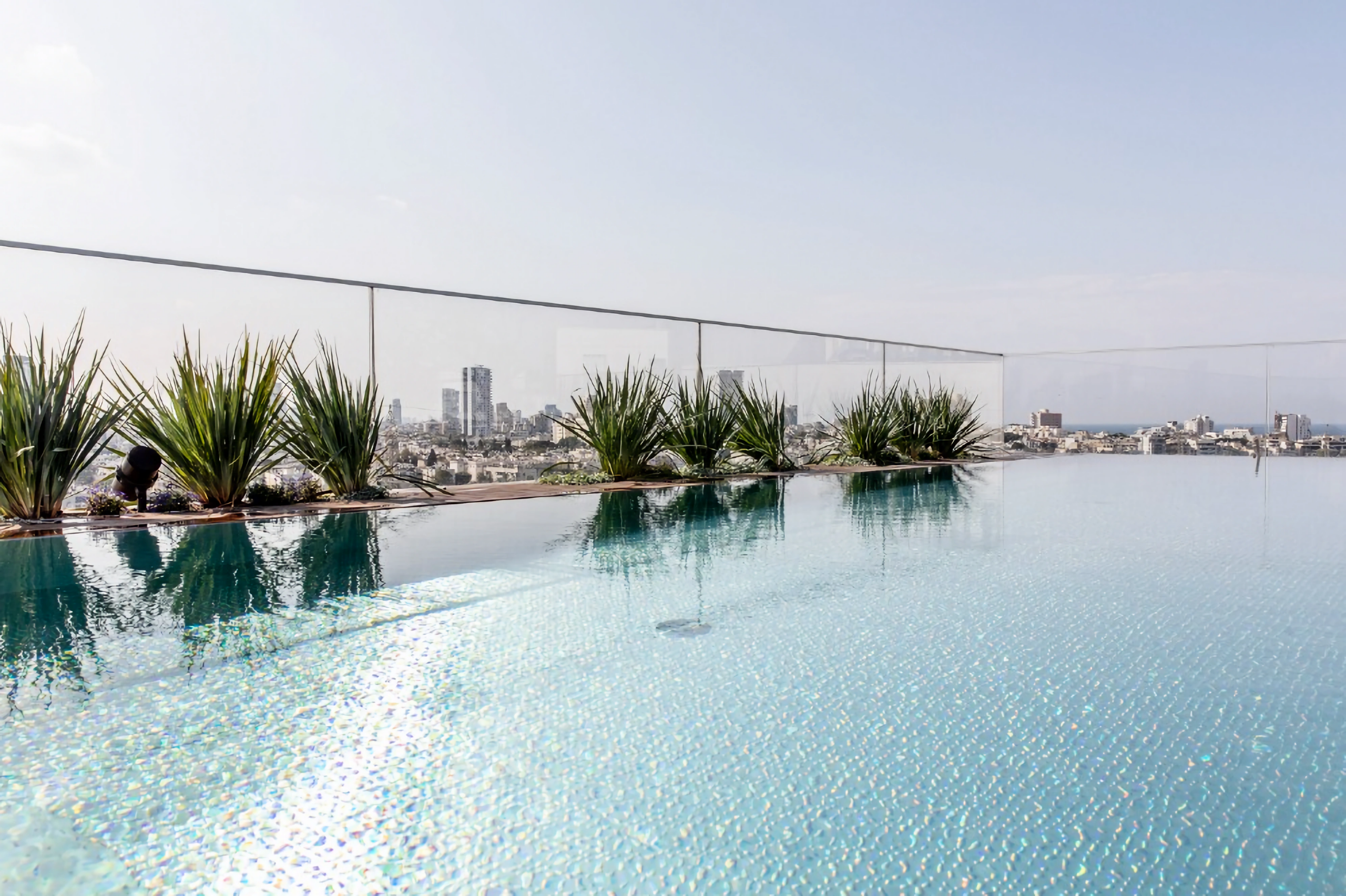
An infinity pool creates the illusion of an boundless body of water merging with the horizon. This effect is at its purest and most impressive on the roof – because the horizon is actually there, beyond the overflow edge, without the obstruction of a rise in the terrain or a neighbouring building.
The stainless steel overflow edge is the best solution for the infinity effect, both technically and aesthetically. An even overflow of water along the entire length of the edge requires absolute horizontality – a deviation of more than ±1 mm leads to an uneven overflow, which is visible both in photographs and in reality. Stainless steel guarantees this levelness in the long term: it does not expand with temperature to such an extent that the edge deforms, it does not sag, and it does not crack.
The result is an infinity image that works perfectly on Instagram or in a property presentation from the very first shot – no post-production, no editing, no waiting for the ideal light. A pool that looks like this every day.

What to check before every rooftop project
A rooftop pool requires the collaboration of an architect, a structural engineer and a pool manufacturer from the outset. Three things to check before the project takes any concrete form:
Load-bearing capacity of the roof structure – an accurate structural assessment for the specific load of water and the pool structure at the specific installation site. Every metre of pool displacement can change the static conditions.
Access route – how the pool or its parts will get to the roof. Crane, roof hatch, safety measures for installation at height.
Technical room – where the filtration, pumps and chemical management will be located. On the roof or one floor down? Each option has different requirements in terms of pipe length and pump sizing.
These three questions are the starting point for each of our rooftop project consultations.
IMAGINOX builds stainless steel rooftop pools for hotels, residential projects and private villas. Each project begins with an analysis of the specific roof – not a catalogue. More about projects and consultation options at www.imaginox.com