A pool on a slope: why sloping land is not a problem, but an opportunity
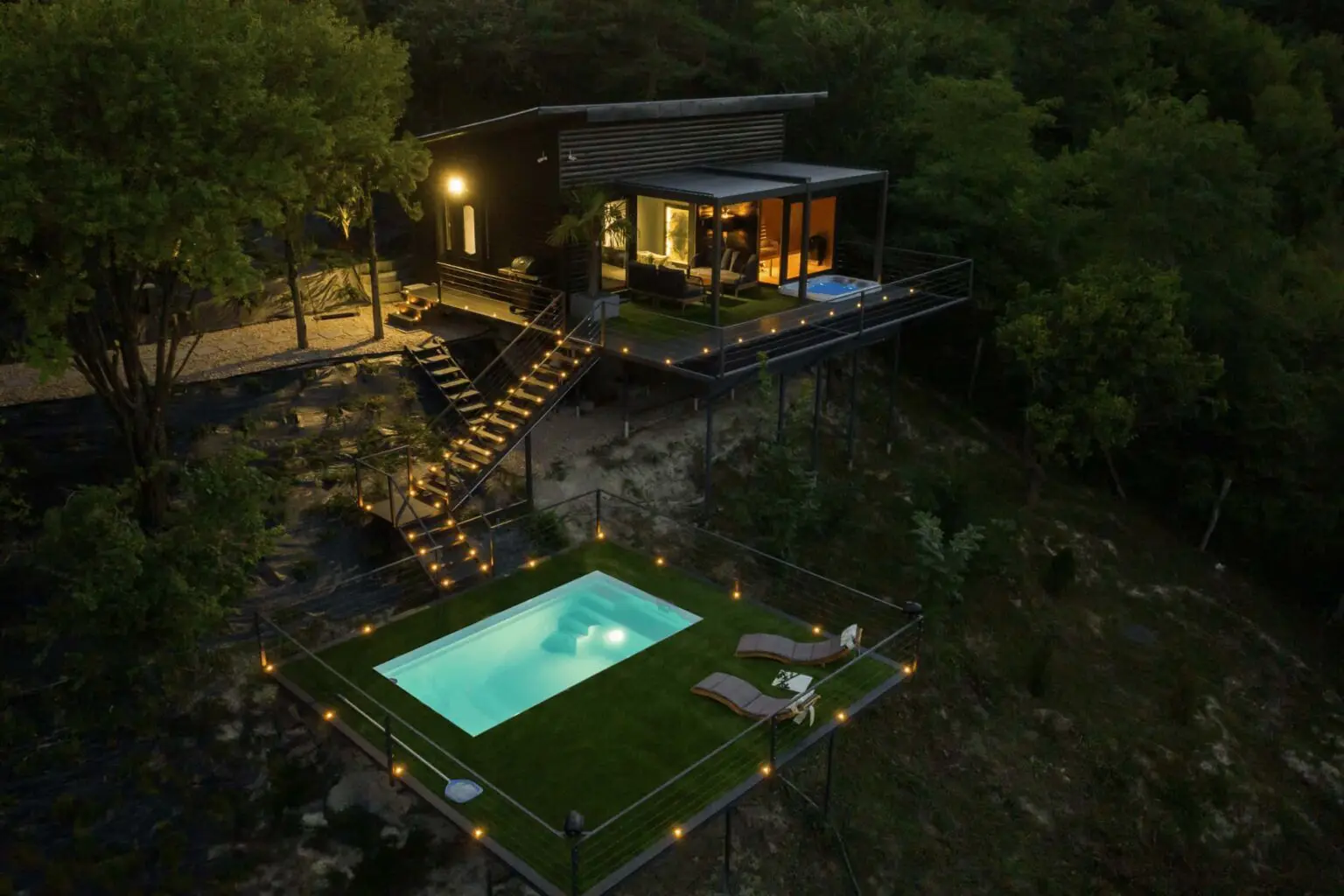
Sloping land is often seen as a complication when planning a swimming pool. In fact, it’s an opportunity — for solutions that simply aren’t possible in a flat garden. A semi-recessed pool on a slope can look significantly more interesting than a classic recessed pool on a flat surface, and if it is well designed, it serves just as reliably.
When are we talking about sloping terrain?
The boundary is clear: a slope of less than 6% is considered moderate and the pool is installed in the standard way. Above 6%, specific solutions come into play. The good news: even a significant slope will not affect the life or functionality of the pool in any way – it just requires a different approach to planning and implementation.
How it works in practice
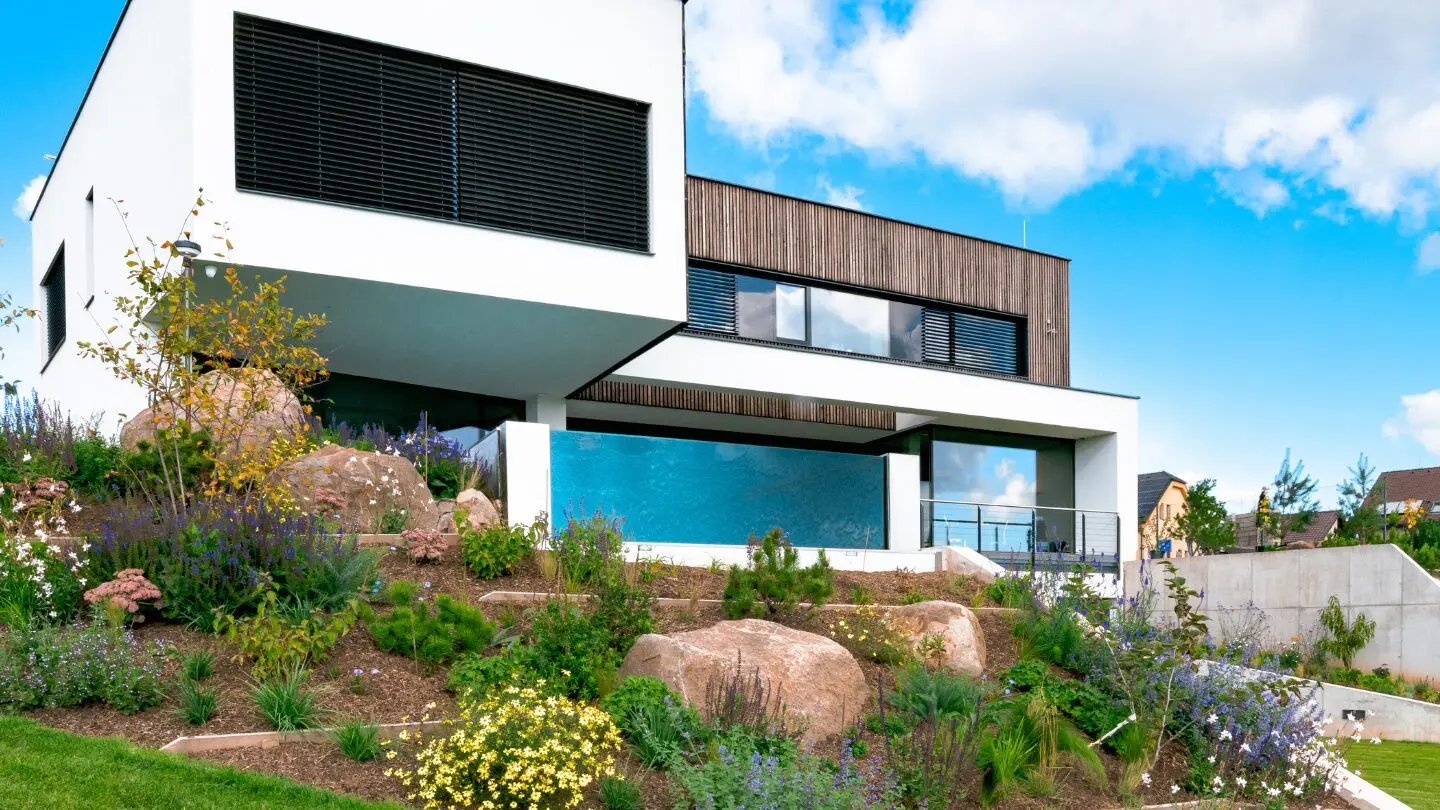
The basic logic of a semi-recessed pool is simple: at the highest point of the slope, the pool is recessed to the edge, and it protrudes above the terrain downwards. The protruding part is supported by reinforced concrete — typically a retaining wall or a landscaped slope with an ornamental rockery.
The result can be a natural terrace around the pool, raised above the lower part of the garden. If the height difference is significant, steps or cascading terrain levels are added, which visually enrich the entire garden. It’s a solution that would never have been created on flat land.
The only thing to keep in mind: the slope can cast a shadow over the pool. It depends on the orientation of the plot and the position of the sun — that’s why a sunlight analysis is part of every good project.

Which pool should you choose for a slope?
Dimensions and depth
For a family pool with children, the standard depth is 1.2 m, or a variable depth of 1.2 to 1.8 m. For swimmers, the bottom should be at least 1.5 m deep, and for diving from a board, a depth of 1.2–2.4 m is required. The ideal length of the pool is between 4 and 7 m, and the width between 3 and 5 m — a larger pool offers more comfort and space for activities, but increases both acquisition and operating costs.
Concrete pool
Concrete is a natural choice for a sloped pool — it is built directly on site, and is therefore also suitable for locations that are difficult to access or have a complicated shape. There is maximum variability: shape, size and colour exactly as specified. The surface can be covered with foil (including 3D variants imitating natural stone or with an antibacterial acrylic layer), paint or tiling. The disadvantage of a concrete pool? Longer construction time and higher initial investment compared to prefabricated solutions.
Stainless steel pool
Stainless steel can also be used on a slope — and the results can be very impressive architecturally. One example is a 13-metre-long stainless-steel pool with one overflow wall and a glass side wall, which creates a mirror effect thanks to reflection. The technology was placed in a shaft under the terrace cladding; the pool is built into the slope on one side and freely accessible on the other. The glass wall was created precisely because the pool naturally raised the slope to a height — this effect could not be achieved on flat terrain.
Stainless steel pools have the advantage over concrete of easier installation and minimal surface maintenance — no liner, no coating, no renovations.

What not to forget when planning
The roofing requires a minimum of 10 cm of free space around the perimeter of the pool and space for sliding — plan the rails from the beginning, not as a retrofit.
Paving or surface around the pool: concrete paving, wood-plastic decks or wooden planks — each variant has a different character and maintenance requirements.
The technology (filtration, lighting, counter-current) is connected after the pool has been installed. For stainless steel and laminate pools, installation is significantly faster than for concrete pools — prefabricated pools are delivered as a whole and placed by crane, while larger stainless steel pools are welded on site.
A slope as an advantage, not an obstacle
The best semi-recessed pools on a slope are not a compromise — they are a deliberate architectural solution. Terraces, glass walls, overflow edges overlooking the garden or landscape, cascading levels. These are all features that sloping terrain allows and flat land makes impossible. If you have a slope, don’t see it as a limitation. Think of it as a starting point for a more interesting project.
Are you planning a pool on a slope and looking for a manufacturer with real experience in similar projects? At www.imaginox.com you will find reference projects, including semi-recessed stainless steel pools in various types of terrain. Every IMAGINOX project begins with an individual consultation — because a pool on a slope cannot be designed from a desk, but always specifically for the given location.
You may be interested
A sauna or a hot tub after a workout? Both work – but in different ways and at different times
A stainless steel rooftop swimming pool: why metal is the best material when every kilogram counts