Trends in infinity pool design: architecture, materials and technologies of the future
The infinity pool has undergone a fundamental transformation over the last twenty years. From an exotic feature of luxury resorts, it has become a standard of premium architecture – and at the same time a space where current trends in design, materials and technologies are most intensely reflected. Minimalism has replaced luxury, stainless steel is replacing concrete and ceramics, and smart technologies are changing the way pools are controlled and managed. This article maps the key trends that define the design of the infinity pool today – from the choice of material, through the design principles of the overflow, to the connection of the interior with the exterior and the role of the location in the overall concept.
Minimalism as the dominant architectural trend
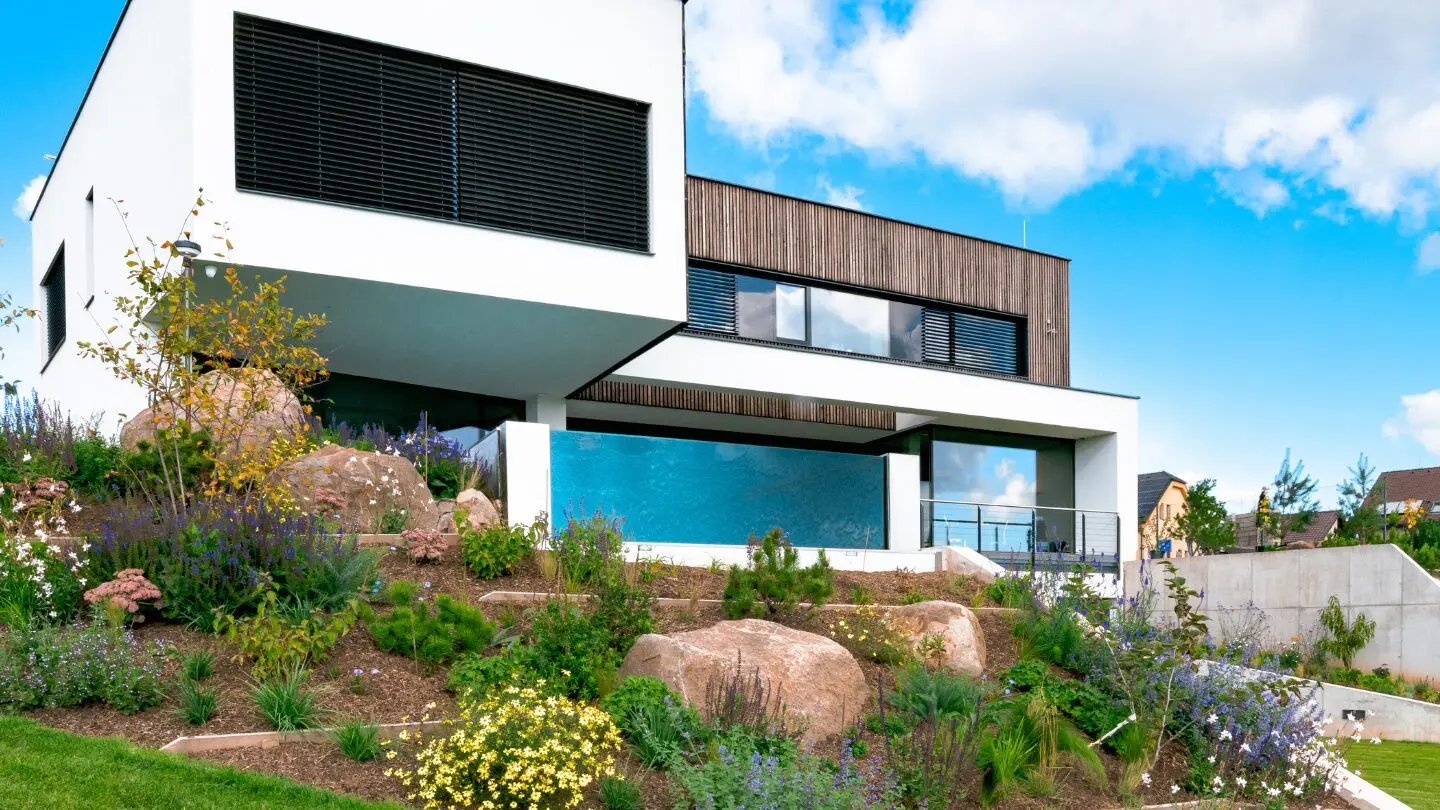
Minimalism in infinity pool design does not mean simplicity. It means precision. Every line must be justifiable, and every detail must work both aesthetically and technically. The trend of recent years clearly shows that the best-rated pool projects are those where the pool is almost invisible – where it blends in with the surrounding architecture so naturally that the viewer first perceives the space as a whole and only then realises where the pool begins and where it ends.
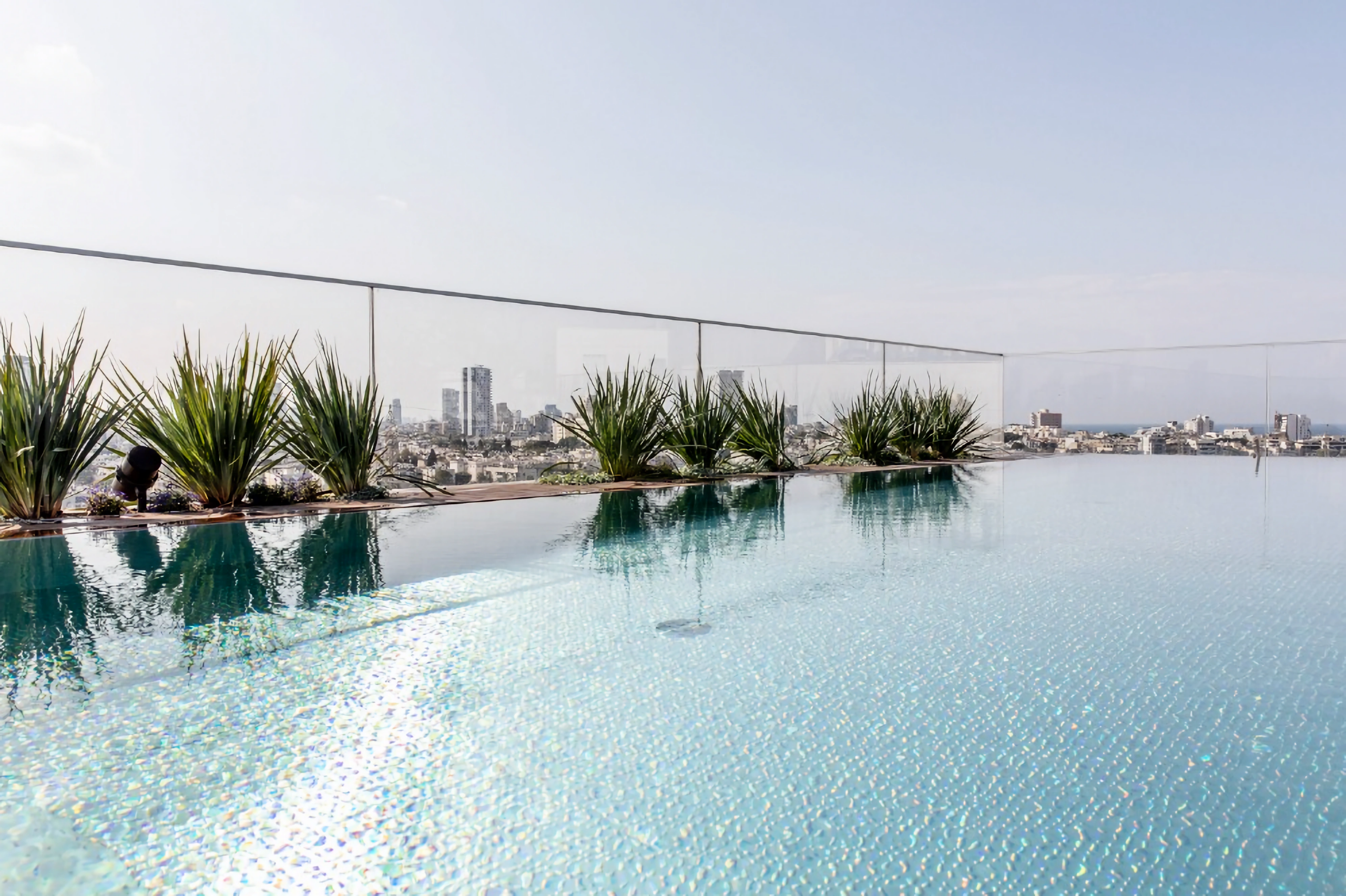
Flush-edge design – an overflow edge at the level of the surrounding terrace or floor – is now a basic requirement for minimalist projects. The water does not end at a visible wall, but flows smoothly into the surrounding area. This effect is technically demanding: it requires millimetre precision in implementation, perfect horizontality throughout the life of the pool, and a material that is not subject to thermal expansion or subsidence. Stainless steel meets these requirements systematically – concrete or ceramics meet them only with significant technical compromises.
Another manifestation of minimalism is the absence of visible technical elements: no visible inlet jets, no skimmers disrupting the surface line, no steps interrupting the geometry of the pool. All these elements are integrated into the structure – hidden in the floor, in the wall or in the overflow channel. The result is a pool whose photography does not require post-production: it looks just as perfect in the picture as it does in reality.

Stainless steel vs. concrete vs. ceramic: a material revolution in infinity pool design
The choice of material is the most important design and operational decision of the entire project. Each of the three dominant materials – stainless steel, concrete and ceramic – offers a different compromise between aesthetics, durability, hygiene and operating costs.
Stainless steel (316L, V4A) is the clear winner in the premium segment in the current trend. Its non-porous surface prevents the build-up of bacteria or algae, regardless of the quality of the coating or foil. The overflow edge remains perfectly flat throughout its service life – stainless steel does not expand significantly with heat, does not sag and does not deform. The surface can be ground to a gloss, satin-finished or left in a matt finish – each variant creates a different light behaviour of the water surface and reacts differently to the surrounding architecture. The service life exceeds 50 years without replacement or repainting. The total cost of ownership over 30 years is lower for stainless steel than for any alternative.
For decades, concrete was the dominant material for large-format infinity pools. Its advantage is absolute freedom of shape – concrete can be cast into any form, including organic curves and non-standard cross-sections. The disadvantage is porosity: the concrete surface must be treated with a coating or lined with ceramic, mosaic or foil, which are prone to cracking, blistering and peeling. After 10–15 years, a concrete pool requires major surface remediation – closure of operations, mechanical removal of the surface layer and new treatment. In hotel operations, this means a shutdown lasting weeks. The precision of the overflow edge is limited by technology in the case of concrete: even a carefully made concrete edge gradually deforms due to settling and temperature cycles.
Ceramics and mosaics offer a rich visual range: from classic white through sea blue to dark anthracite tones, which are currently a strong trend. The dark interior of the pool creates a mirror effect on the surface and dramatically enhances the reflection of the surrounding landscape – which is why this choice is popular in projects with a panoramic view. The disadvantage of ceramics is the joints: each joint is a potential site for the deposition of algae and bacteria and a source of future faults. In the overflow edge, ceramics almost never achieve the precision of stainless steel.
Interior and exterior connection: one of the strongest trends in infinity pool design
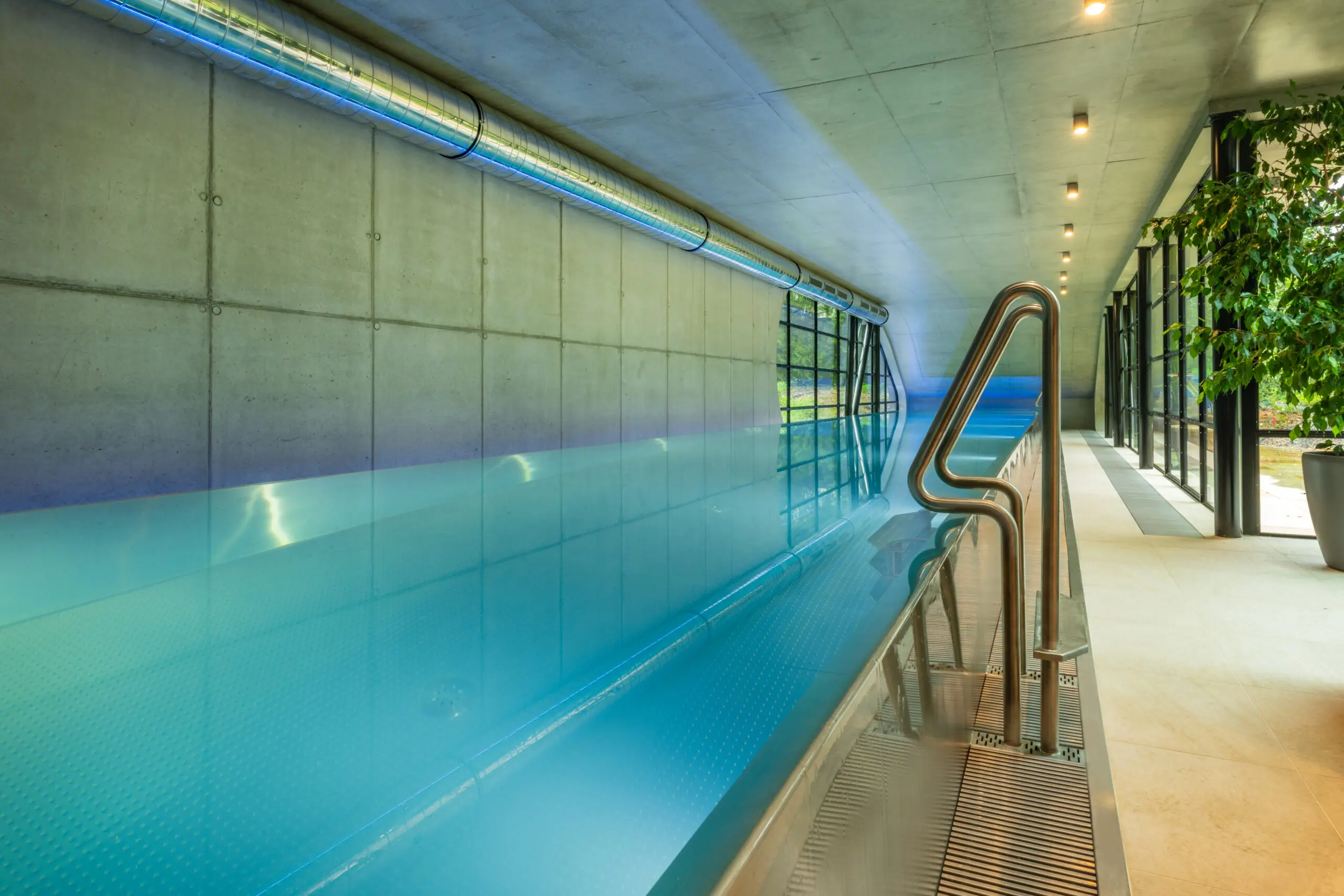
The connection of indoor and outdoor space is now the architectural standard for premium projects. A pool that starts inside the building and continues through a glass or automatically opening wall to the outside is one of the most powerful spatial experiences a pool can offer. A guest or resident of the house can swim from the heated interior to the outdoor section under the open sky – in summer into the sun, in winter under the stars, with a view of the snow-capped mountains or the night-time panorama of the city.
Technically, this connection requires an automatic glass sliding or folding wall with a seal capable of withstanding pressure differences and condensation, temperature control of both parts of the pool (the indoor part typically 26–28 °C, the outdoor part 30–38 °C depending on the season), sound insulation of the machine room to eliminate the transmission of vibrations to the interior, and a special solution for the transition of the pool floor through the building envelope without heat or moisture leakage. Stainless steel is the ideal material for this type of project: its weight is 70–80% lower than that of a comparable concrete structure, which significantly simplifies the structural engineering of the transition through the building’s perimeter structure.
In a hotel context, this type of pool generates exceptional social media value: swimming from the heated interior to the outdoor area in winter is an experience that guests share – and which cannot be easily copied by competitors without equally precise implementation.

Smart technologies in infinity pool design: control, monitoring and energy
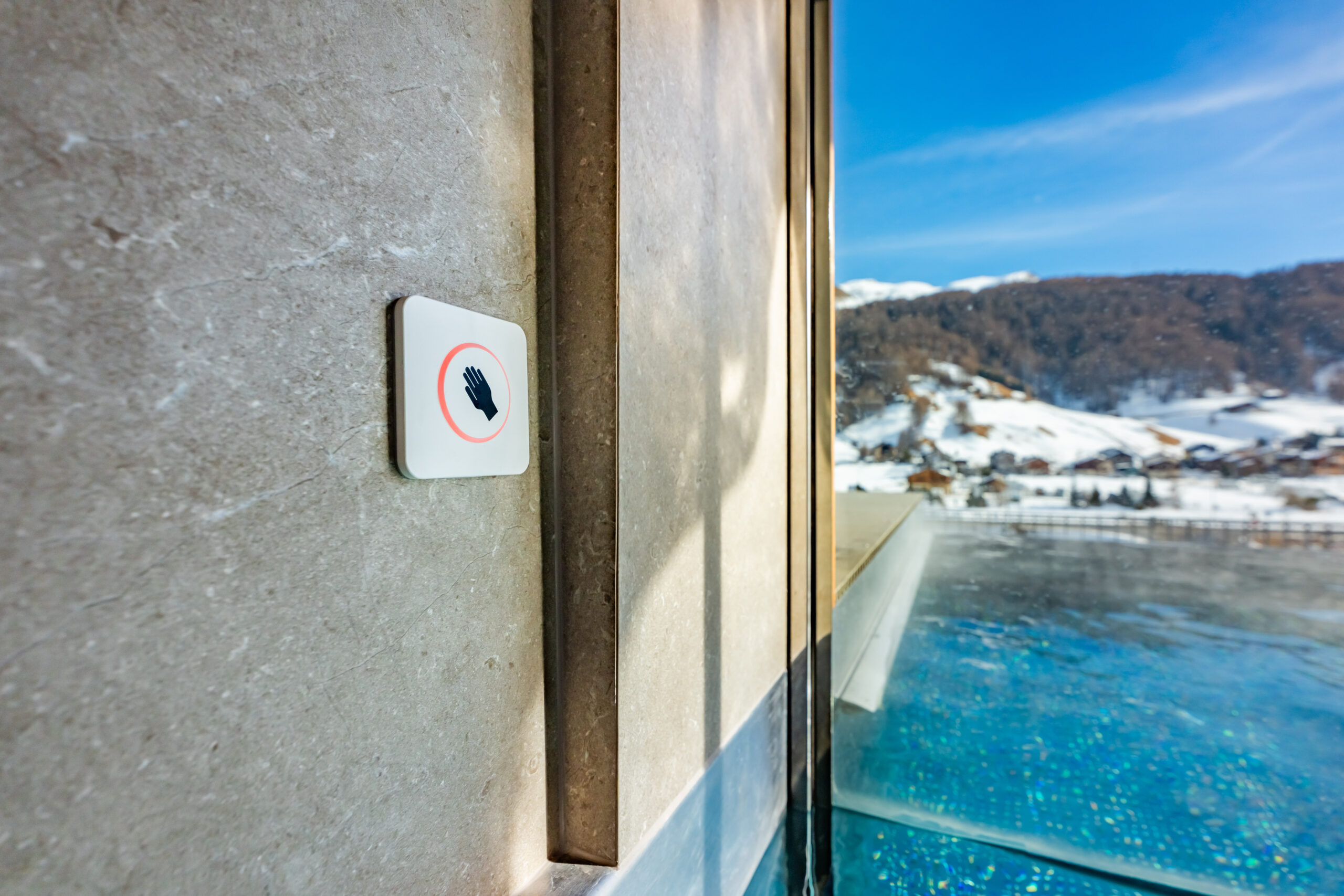
Smart technology is fundamentally changing the way infinity pools are operated and experienced. Today, automated water quality control systems monitor pH, redox value, temperature, flow and disinfectant content in real time – and automatically correct the parameters without operator intervention. For hotel operations, this means a dramatic reduction in the personnel requirements for pool maintenance and the elimination of the risk of human error in chemical management.
Frequency-controlled pumps are now standard in every premium installation: they adapt the output to the current demand and save up to 60% of electricity compared to uncontrolled systems. In combination with a heat pump for water heating and insulation of the pool structure (hard PUR foam, thickness 80–100 mm), the operating costs for heating an outdoor pool are reduced to a fraction of the original values. Automatic mobile covers reduce heat loss by evaporation – the largest item in the energy balance of any heated outdoor pool – by 70-80% during periods of inactivity.
RGB LED lighting certified for permanent immersion (IP68) with Wi-Fi or KNX control allows you to set lighting scenes from a mobile app or tablet panel. The light scene can change automatically according to the time of day, season or current event – relaxing warm tones in the evening, fresh cool white in the morning, festival colour scenes for special occasions. At the same time, this lighting directly affects the pool’s photogenic appeal: the right light scene transforms an average shot into a photo capable of going viral.
Another trend in recent years has been underwater speaker systems, misting systems for terraces and water features integrated into the overflow channel – for example, a thin film of water flowing down a stainless steel wall as part of the overall composition. These elements move the infinity pool from the pool category to the architectural installation category.
Overflow design: the technical basis of the entire concept
The overflow is the heart of every infinity pool – and at the same time the place where mistakes are most often made that destroy the overall effect. A properly designed overflow creates a perfectly even film of water along the entire length of the overflow edge: no interruptions, no ripples, no uneven overflow on part of the edge. This effect is the result of the precise horizontality of the edge (deviation max. ±1 mm over the entire length), the correctly dimensioned flow of the pumps and the precisely calibrated pressure in the supply pipe.
The collection trough under the overflow edge must be dimensioned to accommodate the entire impulse volume of water when a large number of users suddenly enter the pool. An undersized gutter causes overflow outside the system – with an immediate loss of water, chemicals and energy. The buffer tank (minimum 25–35% of the pool volume) ensures that level fluctuations caused by user movement or evaporation do not cause an interruption of the overflow or cavitation of the pumps. This part of the system is most often dimensioned too small – with negative consequences for operational reliability and visual effect.
A stainless-steel overflow edge is the only variant that meets these requirements in the long term and without compromise. In the first few years, a concrete or ceramic edge becomes deformed due to temperature cycles and subsidence, which leads to an uneven overflow – a visible interruption of the water film immediately destroys the aesthetic effect and cannot be repaired without a major reconstruction. Stainless steel remains flat, precise and visually perfect throughout the life of the pool.

Location and orientation: how the location defines the design of the infinity pool
Location is the first and most important design parameter of any infinity pool. A pool is not a product that is selected from a catalogue and placed anywhere – a pool is the answer to a specific place. An Alpine resort overlooking a glacier, a villa on the Adriatic overlooking the sea, a penthouse in the centre of Prague overlooking the city skyline – each location places different demands on the orientation of the overflow, the height of the location, wind protection, structural engineering and thermal economy.
The orientation of the overflow edge is an absolute priority: the edge must point exactly to the best viewing point. The azimuth of the view, the height of the sun in different seasons and times of day, and the line of sight from the most frequently used spot around the pool – these are the parameters that must be part of the architectural analysis long before the first drawing is made. An error in orientation is irreparable without a major reconstruction.
Altitude and climatic conditions determine the technical parameters of the system: in Alpine locations, frostproofing of the entire structure is mandatory, the heat pump’s output must cover winter operation even at temperatures below -20 °C, and the automatic cover must withstand snow loads. In coastal locations, the chloride resistance of all materials is crucial – V4A Edelstahl (316L) tolerates a chloride concentration of up to 400–500 mg/l, while V2A (304) is completely unsuitable for coastal environments. These site specifics must be incorporated into the project from the first consultation.
Luxury vs. standard: where the real difference lies in infinity pool design
The difference between a luxury and a standard infinity pool is not in the price as such – it is in the details that are invisible at first glance, but fundamentally affect the experience and operational reliability. A luxury pool has an overflow edge accurate to tenths of a millimetre, integrated lighting without visible cables, steps recessed into the bottom without a visible break in the geometry, automatic chemical control without manual measurement, and material that looks the same after twenty years as it did on the first day.
A standard pool meets the basic visual requirement of an infinite surface, but compromises in the details: visible joints in the ceramic of the overflow edge, plastic nozzles disrupting the smoothness of the wall, manual control of chemicals, heat loss caused by insufficient insulation, and material that begins to show the first signs of fatigue after five years. These compromises are not visible in renderings or in a photograph from an ideal angle – they are visible in everyday use and in guest reviews after the second season.
IMAGINOX designs and manufactures infinity pools exclusively in the luxury category – made of stainless steel, with millimetre-precise overflow edges, with full integration of smart technologies and with a guaranteed service life of over 50 years. Each project is a unique response to a specific location, architecture and investment plan. Reference projects such as the infinity pool at the Bergwelt Grindelwald hotel or private villas realised in cooperation with leading Czech and European architectural studios show what this approach brings: pools that function as architecture, marketing and investment at the same time. More at www.imaginox.com
You may be interested
A sauna or a hot tub after a workout? Both work – but in different ways and at different times
A stainless steel rooftop swimming pool: why metal is the best material when every kilogram counts