Luxury hot tubs: stainless steel, classic Jacuzzis and premium spas – a comprehensive guide
Hot tub. A word that evokes relaxation, steam rising above the water’s surface and unhurried evenings. But behind this single word lies a whole world of products, materials, technologies and price categories – from inflatable PVC models for a few thousand crowns to architecturally designed stainless steel structures worth several million. This article will guide you through the entire spectrum of luxury hot tubs: what exactly is a Jacuzzi, how it differs from a stainless steel hot tub, what factors play a role in the selection process, and why the material matters more than most buyers think.
Jacuzzi, whirlpool, hot tub, spa – what’s behind it all?
Hot tub terminology is a notoriously confusing area, where brand names, technical descriptions and colloquial terms overlap to such an extent that even experienced salespeople do not always use the terms consistently.
The term “Jacuzzi” is the trade name of a specific brand, while “whirlpool” describes a type of bath with jets. A breakthrough moment for Jacuzzi came when one of the brothers, Candido, invented the first portable hydromassage pump to help treat his son with rheumatoid arthritis – the pump could be placed in any bathtub and turn it into a therapeutic device. Since then, the name Jacuzzi has become synonymous with luxury hot tubs in general – much like Xerox for photocopiers or Teflon for non-stick surfaces.
Whirlpool baths are specifically designed to create a swirling flow of water and provide a therapeutic massage effect. Like hot tubs, they can be found in homes, hotels, spas and physiotherapy clinics.
For the practical purposes of this article, the following applies: when we talk about luxury hot tubs, we are talking about products that combine heated seating with hydromassage – regardless of whether they are made of acrylic, GRP or stainless steel.
Classic Jacuzzi: acrylic, GRP and premium technology
Classic Jacuzzis and hot tubs are the most common type of luxury hot tub in the world. They are available in a huge variety of shapes, sizes and price categories and offer sophisticated massage technology that has undergone significant development over the last twenty years.
Materials of classic Jacuzzis
Hot tubs are larger and use lighter and cheaper-to-mould materials such as acrylic and fibreglass for their production. Jacuzzis can use higher-quality materials such as ceramics and stainless steel for beauty and durability.
Acrylic is the most common material used in premium hot tubs. Acrylic shells are produced by vacuum forming into a mould and are available in countless colours and shapes. Modern acrylic is strong, retains heat well and, with proper care, looks good for many years. The disadvantage is the porosity of the surface, which degrades over time due to scratching and UV radiation, and the need for regular replacement after 10–15 years.
GRP (glass-reinforced plastic) is a stronger alternative to acrylic, used primarily for outdoor installations. It withstands temperature fluctuations better than acrylic, but is also subject to gradual surface degradation.
In addition to standard acrylic variants, Jacuzzi® premium models also offer models with decorative stainless steel cladding on the outer shell, ice or heating zones and advanced control systems.
Massage technology in classic Jacuzzis
By combining air with a pressurised water jet, whirlpool baths provide targeted relief of muscle tension, focusing on the lower back, neck, shoulders and legs.
Modern premium Jacuzzis use several types of hydrotherapy:
Whirlpool system – classic water jets combined with air. A powerful, directional jet that physically massages muscle tissue. Ideal for athletes and people with chronic muscle tension.
Air jet system – instead of a water jet, they release thousands of tiny air bubbles that float under the water surface and gently massage the entire surface of the body. Less intense than water jets, but significantly more pleasant for sensitive skin.
Combined systems – premium models combine both and allow you to switch between massage modes or combine them.
Premium luxury models today also include infrared and red light therapy.
Installation and operation of a classic hot tub
An empty hot tub can weigh up to 300 kg and, when filled, up to 2,000 kg – weight is a crucial factor during installation. An outdoor hot tub typically requires a solid foundation (a concrete slab or a terrace with sufficient load-bearing capacity), a 380 V power supply and a water connection. The average energy consumption of a conventional outdoor hot tub ranges between 1 and 3 kWh per hour of operation while maintaining the temperature.
The chemical management of a classic acrylic hot tub requires regular pH checks, dosing of disinfectant (chlorine, bromine or active oxygen) and cleaning of the jets, which can be a site for biofilm. Changing the water is recommended every 3 months.
Stainless steel hot tub: an architectural object with a therapeutic function
A stainless steel hot tub is a categorically different product from a conventional hot tub – not only in terms of the material, but in the whole philosophy behind how it is made and how it works.
Why stainless steel changes the whole approach
A stainless steel hot tub is not a prefabricated shape to which jets are added. It is an architectural object designed for a specific location, specific users and a specific context. Each stainless steel hot tub from IMAGINOX is custom-welded – in terms of dimensions, shape, jet configuration, surface finish and accessories.
V4A (316L) material is the standard for both commercial and premium private installations. It contains a composition that ensures resistance to chlorides, UV radiation, frost and chemicals. The passivation layer regenerates spontaneously when scratched – the surface “heals” through contact with atmospheric oxygen.

Key features of a stainless steel hot tub compared to a conventional one:
The non-porous surface with a roughness of Ra ≤ 0.8 µm prevents the accumulation of bacteria and algae without reliance on chemicals. This is essential for commercial operation: less chemistry, more stable water parameters, lower risk of biofilm in the jet system.
The service life exceeds 50 years without shell replacement, without repainting, without renovation. The total cost of ownership over 30 years is significantly lower for a stainless steel hot tub than for an acrylic one – even though the purchase price is higher.
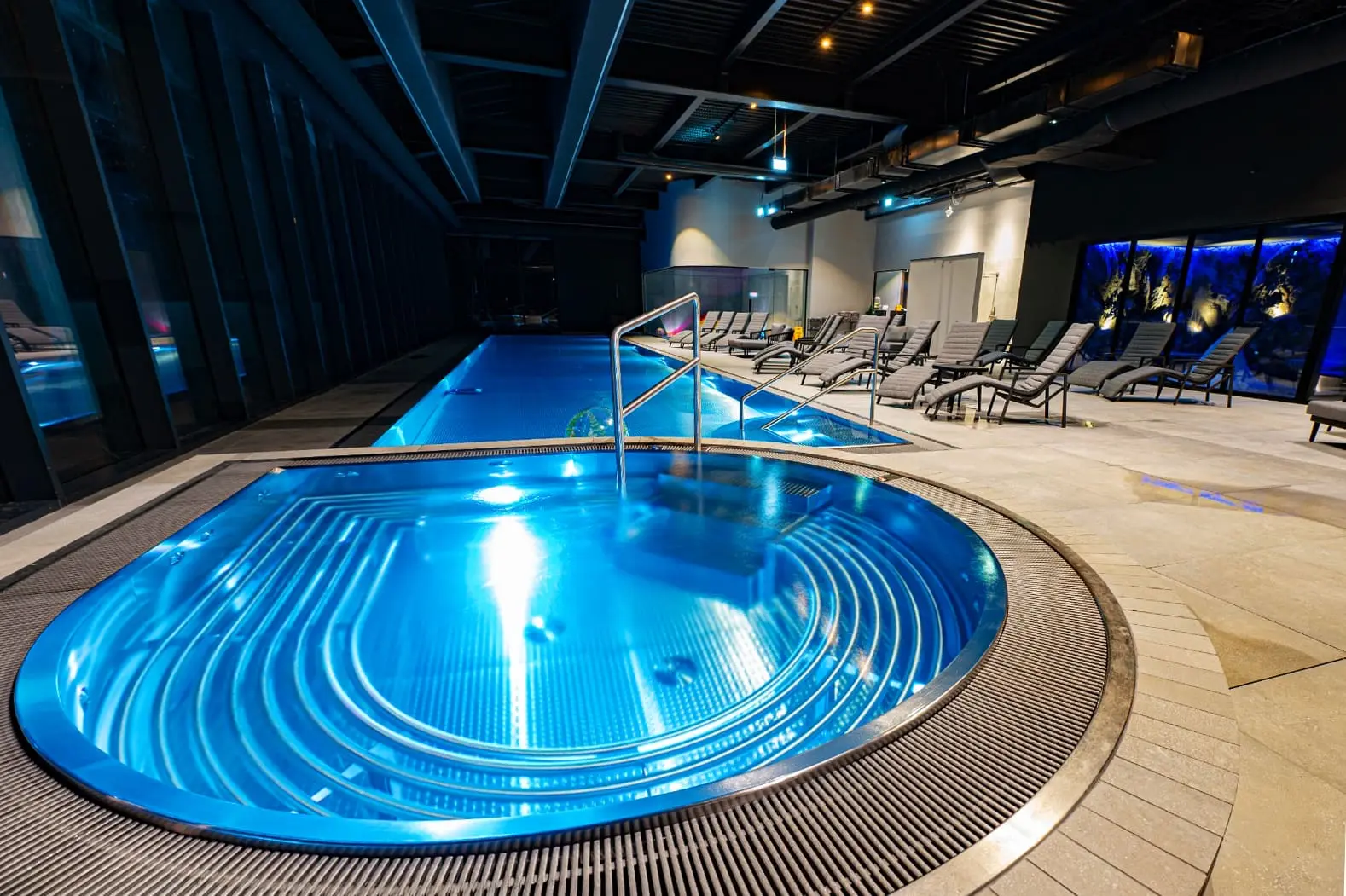
Freedom of shape – a stainless steel hot tub can have any shape that the architectural design requires: octagonal (as with the Vltavan Sport hot tub with 86 jets for 12 people), with an overflow edge, with an integrated movable terrace or with a glass wall allowing a view into the depth of the water.

Health benefits of hot tubs: what science says
The health benefits of warm water are scientifically proven – but they are based on the physics of hydrotherapy, not on a specific brand.
Three physical principles that together explain the therapeutic effect of every hot tub:
Heat (36–40 °C) – causes vasodilation – the widening of blood vessels – and thus increases blood flow to peripheral tissues. The muscle fibres relax, the synovial fluid in the joints warms up and becomes less viscous, and the joints move more freely. Cortisol – the stress hormone – decreases, while serotonin and dopamine increase.
Buoyancy – reduces effective body weight when immersed up to the neck to 6–8% of total weight. The joints and spine are relieved of 92–94% of the gravitational load. For people with arthritis, post-operative conditions or chronic joint pain, this is direct relief that no other therapy can replicate so easily.
Hydrostatic pressure – the even pressure of water on the entire surface of the body – acts as a whole-system compression: it reduces swelling in peripheral tissues, mobilises fluid from the lower limbs back into the central circulation and reduces the load on the heart when pumping.
Added to this is the mechanical effect of the jets – the Gate-Control Theory of Pain explains why the pressure massage stimulus “overrides” pain signals at the level of the spinal cord. The result is a reduction in the subjective perception of pain without any pharmacological intervention.

How to choose a luxury hot tub: a decision-making framework
Private residence
For a private house or villa, the key parameter is the connection of the hot tub with the architectural concept of the space. A stainless steel hot tub that visually connects to the terrace, the swimming pool or the indoor wellness room has significantly greater architectural value than a standard acrylic model.
The issue of year-round operation is also important: a stainless steel hot tub is frost-proof without exception, while outdoor acrylic models require certain measures in cold winters.
For private use with 2–4 users, a compact stainless steel hot tub (typically 1.8 × 1.8 m or 2.2 × 2.0 m) or a premium acrylic model for 4–6 people from the higher price category is suitable.
Hotel and commercial use
Stainless steel hot tubs can be manufactured in any shape and size and are extremely durable. For hotel operations, this durability, combined with the hygienic properties of the surface, is absolutely crucial.
A hotel hot tub must be able to handle dozens of users a day, all year round. An acrylic model degrades significantly faster under such a load – the surface scratches, the jet system clogs, and chemical management is more demanding. A stainless steel hot tub systematically eliminates these problems.
For large hotel wellness centres, overflow stainless steel hot tubs for 8–12 or more people with automatic filtration, a control system integrated into the central wellness panel and LED lighting with colour scenes are relevant.

Conclusion: luxury that makes sense
A luxury hot tub – whether stainless steel or a classic Jacuzzi – is not an expense. It is an investment in everyday well-being, in the value of the property and, in the hotel context, in direct operating income. Real estate market data show that properties with a premium hot tub sell 10–25% faster and at a higher price. Hotel testimonials repeatedly confirm that guests actively comment on the hot tub in their reviews and return because of it.
The key is to match the product to the context correctly: for commercial and architecturally demanding projects, a stainless steel hot tub is unrivalled. For private residential projects with less space or a lower budget, premium acrylic hot tubs are a fully-fledged alternative with their own strengths.
IMAGINOX designs and manufactures bespoke stainless steel hot tubs for hotels, residences and wellness centres around the world. Every project starts with a consultation – because the right hot tub isn’t the most attractive one in the catalogue, but the one that fits your space and lifestyle perfectly. More at www.imaginox.com
You may be interested

IMAGINOX is introducing a new brand identity. New look, same values.
Sensory showers for hotel wellness centres: a multi-sensory ritual that guests will never forget