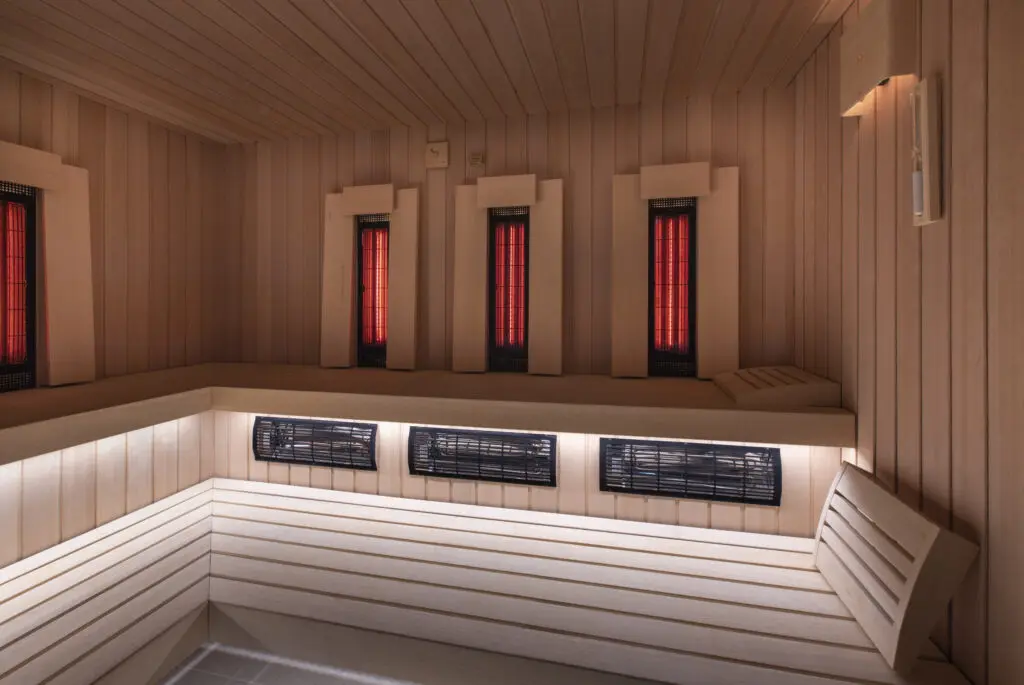
An interview to mark the 10th anniversary of the partnership between Imaginox and Hotel Bedřichka.

Ten years ago, the Hotel Bedřiška in Špindlerův Mlýn expanded its services to include a custom-built wellness facility by Imaginox (formerly Aquamarine Spa). This year, both companies are commemorating the tenth anniversary of their collaboration. To mark the occasion, we have conducted a joint interview with Ing. Roman Laine, the owner of Hotel Bedřiška, and Jiří Kachlík, the CEO of the Imaginox Group. The two men are connected not only by a decade of collaboration, but also by a close friendship.
What does Hotel Bedřiška mean to you?
RL: Simply: a matter of the heart. It will never be put up for sale.
The hotel was built as a recreational facility during the First Republic period. It has a rich history, which was not always happy during the communist era. What were your goals and feelings when you reopened the hotel in the 1990s?
RL: The truth is that we bought the hotel already reconstructed and open. At the time, only the original building in which we are sitting now existed, and the rest was gradually added.
Wellness was only added to the hotel’s operations 10 years ago – 11 years if we count the construction period and trial operation. How did the opening of the wellness facility transform your hotel’s positioning and guest composition? What benefits did opening the wellness facility bring?
RL: Wellness brought us a lot. We moved up a notch. We acquired a completely different clientele to what we had before because, previously, mainly German tourists came here.
After the revolution, we didn’t have the same advantages as the hotels around us, which were already well known from the communist era. Our hotel wasn’t very well known, and it’s also located somewhat ‘at the end of the road’, so it was difficult at first to establish a successful business here. Thirty years of hard work have gone into achieving this. Thanks in part to wellness, however, we have managed to turn this disadvantage into an advantage. Our clients are very wealthy (we are currently the most expensive hotel in Špindlerův Mlýn) and want peace and quiet.

For Imaginox, this was one of the first projects following the establishment of its own stainless steel production. Jiří, what makes the wellness hotel Bedřiška exceptional?
JK: Wellness at Bedřiška was realised at a time when our production volume was much lower than it is today. I was still helping out in production and at assembly sites back then, and I also spent several nights and days doing manual work at Bedřiška. One thing that makes Bedřiška exceptional for me is that we built beautiful wellness facilities which were absolutely unbelievable at the time. Secondly, I met Roman, who was truly committed to building a proper wellness facility, which is not common among many investors. Even today, when we visit the wellness facilities, we don’t get the feeling that they’re ten years old. I think it’s thanks to Roman that he said: “We’ll do it properly. Either properly or nothing.”
According to global data, the worldwide wellness economy is growing at a rate of 7.9%. This reflects the demands of hotel guests, with up to 80% choosing a hotel based on whether it offers wellness services. Does your experience confirm this? Why do you think it’s important for a hotel to have well-designed, quality, modern wellness facilities?
RL: The answer relates to pricing, as well as the new clients we’ve acquired. It’s also an advantage for us that you can’t build much in Špindlerův Mlýn, and that few people will build wellness facilities. So, for us, focusing on wellness was a crucial change. Clients require it and enjoy coming and returning here. We try to take a family-oriented approach, which clients appreciate because they receive all the care they need and prefer to spend their time here rather than in large concrete hotels, even though those also have nice wellness facilities. It’s also about being more personal.
Could you describe the economic benefits of wellness for your business? Data from the 2025 Hot Stats analysis shows that, on average, hotels with wellness facilities achieve up to 108% higher revenue per room. Wellness programmes extend guest stays, providing an incentive to stay even in bad weather and increasing return visits. How would you describe the economic benefits of wellness based on your experience?
RL: We certainly reap economic benefits from wellness. This is primarily due to higher occupancy and the ability to charge a higher room rate. Without wellness, the hotel would not achieve the same results. If you want to provide guests with a quality service, wellness is a necessity nowadays.
What percentage of your guests use wellness services during their stay?
RL: I would say 100%.
How does the experience at Hotel Bedřiška confirm the requirements of Imaginox’s clients, compared to other hotel operations you encounter in your work?
JK: Every hotel has a different approach to wellness. It depends on the type of hotel. If it’s a relaxation or mountain hotel, for example, wellness facilities will be used by almost all clients. The capacity and overall concept of wellness in a city hotel is different. City hotels have an average stay of around two nights, so perhaps only around 20% of clients use the wellness facilities. However, overall, all investors recognise that wellness is becoming an increasingly important part of the hotel experience. Nowadays, wellness is one of the three main factors in hotel selection. The first factor is location, which the hotel usually cannot change. The second factor is wellness, and the third is the restaurant. Of course, they must also meet certain standards in terms of rooms, reception, and so on.
Outdoor wellness facilities are becoming increasingly popular. The fact that clients can access an outdoor space as part of the wellness offering provides a different type of comfort. Today’s trend is that people want to be closer to nature. However, even indoors, more and more space is being allocated to wellness areas, which often have glass walls offering views of the surroundings. Architects who design wellness hotels argue that by placing wellness facilities in the most beautiful spot, they are able to offer that spot to every client who visits the hotel. If wellness facilities are located in the basement, with luxury rooms in the best spot, then only ten percent of visitors will have access to the most beautiful area.
Do you think wellness itself is still a competitive advantage for a hotel? Or does the competitive advantage increasingly lie in how wellness is built, the services it offers, the design, the treatments or the premium quality?
RL: I think the type of service offered is also important, and we have created lots of wellness attractions here. For example, our floating therapy is still unique within the Czech Republic. I don’t think Imaginox has implemented many of them since then.
JK: No, it’s very exceptional. It’s a procedure that has many health benefits. Clients relax in darkness and silence in warm, highly saline water, which is reminiscent of the Dead Sea environment. This naturally makes the body buoyant, allowing for complete relaxation.
RL: Yes, it’s simply different, and we wanted something extra. And I must say, we succeeded. Wellness is crucial to me. I’m very glad we met with Jiří because my life motto is that if I do something, I do it properly or not at all, as has been mentioned here.
JK: Building wellness facilities to a high standard is one thing, but operating them to a high standard is another. Even the best wellness facilities cannot do without careful regular maintenance by the hotel operations if they are to look the way they do here at Hotel Bedřiška after so many years.

Let’s also look at this issue from a marketing perspective. Do guests mention wellness in their reviews of your hotel?
RL: Absolutely. As we’ve already mentioned, offering wellness and maintaining high-quality standards is absolutely essential. It does appear in reviews.
My second question is related to marketing. Hotel marketing is being transformed nowadays, particularly by the so-called Instagram effect. This demonstrates that the visual quality of the experience is important too. Hotels are advised to create photogenic spaces that will be distinctive. In my opinion, you have one of these in the form of the swimmer statue above the pool and the Sky Diver sculpture. Do you agree? What is the story behind this sculpture?
RL: Yes, I do. Sky Diver was actually a coincidence. About twelve years ago, I was in the United States with my family and we visited a gallery where this sculpture was hanging. I knew immediately that we simply had to have it. We bought it, and then laboriously transported it to the Czech Republic because it’s quite large. It took about ten months to arrive. You’re right that it’s the central point for photography, and it’s actually a kind of signature for the entire wellness area. Moreover, the sculpture is world-famous. There are also about ten of them hanging in Dubai Mall in Dubai. So it’s not unique, but it’s still important to me.
JK: When I first started coming here, my children were still young. They’ve grown up now, but even this morning, on my way here, my adult son asked me, “Where are you going?” ‘Where are you going?’ I said: “To Špindlerův Mlýn, to the Hotel Bedřiška.” “Oh, like the sculpture above the pool.” I said: “Yeah, yeah, like that sculpture above the pool.” He remembers it from his childhood. When the children were young, they would always say: “Dad, we have to go to that hotel again, the one with the sculpture above the pool.” It was easy for even small children to remember, so it was always a popular choice.
Such an iconic feature used to be a good way to make an impression and encourage recommendations; nowadays, it’s all about social media. What other element similar to the original sculpture can attract guests’ attention and likes on social media when promoting a hotel’s wellness facilities? What increases the attractiveness of wellness operations today?
JK: We’re currently working on several projects that feature glass pools. For hotels, we’re installing glass pools in areas where guests walk from the ski slope, so they can see them. Again, the aim is to stand out. For hotel guests, it’s about the views. Infinity pools are popular – for example, the most famous one in Europe is at the Hubertus hotel in Italy, designed by the architectural studio NOA, with whom we are now collaborating. The Hubertus hotel’s pool has generated significant revenue and fame. Now everyone knows what the hotel looks like. Based on their experience with the pool, they later built a sauna complex elevated into the air on stilts.
In summary, I believe it’s important to have a photo opportunity, as tourism today is driven by people wanting to take photos for social media. Secondly, people develop a relationship with places they like to return to. Whenever they think of that hotel, they picture that place, that feature. Like the Sky Diver sculpture here.
This year, you’re celebrating 10 years of cooperation. This doesn’t just refer to the construction and commissioning of the wellness facility 10 years ago, but also to 10 years of ongoing service. How would you evaluate the cooperation?
JK: Imaginox has provided regular maintenance throughout this entire period. Bedřiška has a monthly service schedule with us. At the same time, we established operating procedures that must be followed after the spa was completed. The operator here adheres to them strictly, and thanks to that, the wellness facility is in perfect condition.
RL: It’s also related to the fact that the wellness facility was built properly from the outset. What I appreciate most is the stainless steel workmanship, which is a long-term solution – the pool doesn’t need any maintenance and still maintains its quality.
JK: Even a stainless steel pool needs proper care. Wellness is like a kitchen in that it can’t function by itself; it needs a chef. Similarly, wellness requires competent management.
My final question is: what are your plans for the future? Do you think you’ll work together on another project?
RL: I definitely think so, because we don’t intend to stop developing. Right now, we’re working on permits and changes to the zoning plan for the continued expansion of buildings. There will be accommodation for staff and a conference centre to attract corporate clients. Then we’d like to move on to outdoor wellness. We’re planning an outdoor hot tub with a view and possibly an outdoor pool and some saunas. We’re moving forward together.

You may be interested

IMAGINOX is introducing a new brand identity. New look, same values.
Sensory showers for hotel wellness centres: a multi-sensory ritual that guests will never forget