From the indoor pool straight outside: the technical challenges of year-round indoor-outdoor wellness

Connecting an indoor and an outdoor pool is one of the most challenging tasks in the design of hotel and residential wellness facilities. The water surface, which flows seamlessly from the heated hall into the open air, creates an exceptional architectural and experiential effect. Structurally, however, it is an element that passes through the building’s outer shell and must simultaneously cope with a humid interior and a wintry exterior. The design must therefore take into account heat loss, condensation, frost protection, waterproofing and the design of the overflow as a single, interconnected system.
The article is based on three IMAGINOX projects – the Al Nin Hotel & Spa and the Hotel Damelis in Livigno, and the Fairmont Golden Prague – and summarises the technical principles that need to be addressed as early as the study phase.
Key findings
The water is shared in a connected pool, but the air, wind and radiation differ significantly in both zones. This is what determines the heat balance.
– The greatest heat loss is evaporation from the surface. Automatic covering is therefore an essential element of the design, not an accessory.
– It is primarily the technology, pipes and edges that are at risk from frost, not the stainless steel pool itself.
– The passage of the pool through the façade requires a continuous thermal, vapour barrier and waterproofing plane.
– It is advisable to control all elements, i.e. cover, circulation, heating and lighting, with a single system.
Specifics of a connected pool
A connected pool is a single body of water in two different environments. Inside, the air is stable, warm and humid. Outside, there is frost, wind, snow and variable sunlight. The boundary between the two zones passes through the pool itself.
Passage through the outer shell
The point where the pool passes through the façade is the most sensitive detail of the entire design. It addresses four problems.
Thermal bridge. The sheet metal tub leading from the interior to the exterior is a thermal bridge. Stainless steel conducts heat significantly less well than aluminium or carbon steel, but the passage of thin sheet metal through the façade nevertheless requires a thermal break and insulation so that the building’s insulation plane is not interrupted anywhere.
Condensation. In winter, the outside of the glazing is cold, while the hall contains humid air. Moisture condenses on cold surfaces. The solution is usually a combination of high-quality glazing, a heated frame, controlled airflow along the glass and dehumidification of the hall. Covering the surface also helps: lower humidity in the hall reduces condensation and can extend the service life of the structure.
Opening size. The larger the opening in the building envelope, the greater the air exchange between the interior and the exterior. The opening should be sized for the safe passage of swimmers and its operation should be automated so that it is only open for the necessary time.
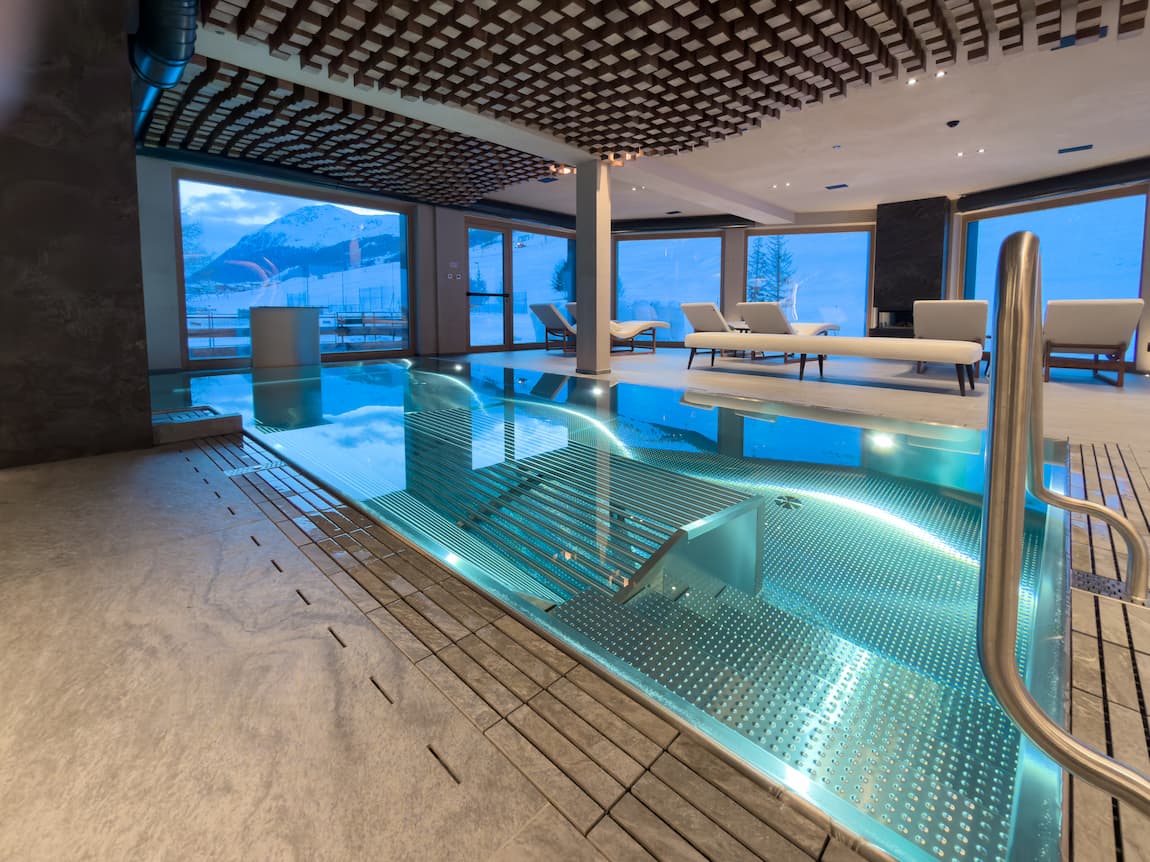
Safety of passage. The passage must be adequately lit, free of sharp edges and with non-slip treatment of the surrounding surfaces. In Damelis, the passage is designed as a glass corridor, which ensures a comfortable transition from the interior of the hotel and visually unifies the entire wellness zone.
The specific technical solution for the swim-through opening is always based on the layout, climate and operation of the project in question.

Heat balance
If the pool is a single body of water, it has a single water temperature. The difference between the interior and the exterior therefore lies in the air, wind and radiation above the surface.
Evaporation. According to the US Department of Energy, evaporation accounts for approximately 70% of heat loss in both indoor and outdoor swimming pools, and covering the surface is the most effective measure to reduce heating costs by 50 to 70%. Almost all losses, approximately 95%, occur at the surface, mainly through evaporation and radiation into the sky.
Wind. A wind speed of approximately 11 km/h above the surface can increase heat loss by up to 300%. For the outdoor section, it is therefore advisable to address the leeward side with landscaping or a screen. Inside the hall, the opposite rule applies: the calmer the air above the surface, the less evaporation, although a slight flow is necessary to remove chloramines.
Water attractions. Swirled or sprayed water has a larger surface area, and evaporation therefore increases. It is therefore recommended that counter-currents, water jets and air jets be operated only in operating mode.
Solar gain. An outdoor pool absorbs 75 to 85% of the solar radiation falling on the surface. In winter, this is a useful gain in clear weather, but at night and in cloudy weather, heat loss through radiation prevails.
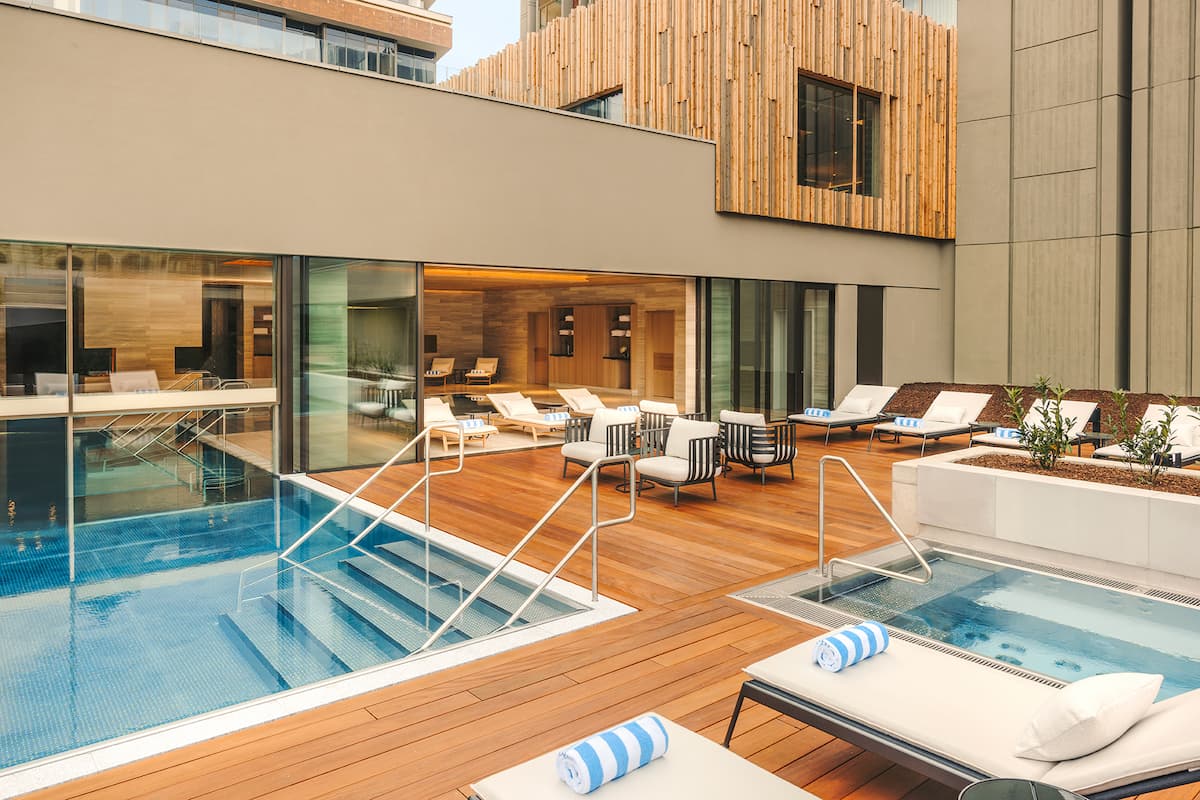
Covering the surface. That is why all reference pools are equipped with automatic covers. At Fairmont, a slatted cover covers the entire surface and is concealed in an outdoor shaft. At Al Nino, a built-in cover covers both parts of the pool. At the Fairmont outdoor hot tub, an automatic slatted cover with remote control helps reduce heat loss. In addition, the cover reduces the need for dehumidification and heating of the air in the hall when not in use. Operational experience from British swimming pools shows that insulated covers typically save 10 to 30% of a pool’s total energy, with a payback period of 18 months to three years. This figure is general; the specific return on investment depends on operation and climate.
Separate hot tub. The water in a shared pool is always a compromise. If guests require the temperatures usually found in a hot tub, this is addressed by a separate facility: at the Fairmont, an outdoor stainless steel hot tub with an overflow around the entire perimeter for up to five people, and at Al Nino, a hot tub on the first floor in the outdoor area.

Frost protection
During operational heating, the water in the pool does not freeze. Technology, pipes, heat exchangers, shafts, overflows and edges are at risk.
- Freezing water expands, increasing the pressure in the pipes and potentially causing them to burst.
- Both metal and plastic pool components are sensitive to freezing forces, so heat exchangers must be protected.
- Flowing water freezes less, and circulation should therefore continue even in freezing temperatures.
A particular risk is a power failure. If circulation stops in the middle of a frost, stagnant water in the system can freeze within a few hours. This gives rise to the following principles:
Place the technology in a heated area. At Damelis, the equipment is located in a separate technical shaft and includes filtration, circulation pumps and an automatic water quality control system.
Insulate the pipes in all sections running outside the heated area, including penetrations and distribution pipes under the terrace.
Frost-resistant control mode, which, depending on the outside temperature, starts circulation independently of operating hours.
Backup power supply for circulation pumps and control unit. This is a recommendation based on operational experience, not a standard requirement.
Option of rapid draining of exposed parts of the system.
The material of the pool also plays a role in the decision-making process. For the Livigno project, the reference states that the stainless steel construction guarantees a long service life, resistance to frost and chemicals, and easy maintenance. In freezing conditions, it is primarily the technology and the distribution systems that are fundamentally at risk, not the sheet metal pool itself.
Frost also affects the area around the pool. The outdoor steps, overflow gutter and terrace can freeze, so it is advisable to take into account heated surfaces and non-slip treatment. At the Fairmont, the bottom of the pool is fitted with round studs.
Waterproofing and expansion joints
The welded stainless steel pool shell is watertight in itself, as it has no tiling joints or liner. This is a major advantage over a concrete pool with a ceramic surface. However, waterproofing also applies to the connection of the pool to the building.
Thermal expansion. Stainless steel expands more than carbon steel or concrete when the temperature changes. As a rough guide, this is in the order of millimetres over a length of ten metres when the temperature changes by several tens of degrees. The part of the pool inside the hall and the part exposed to outdoor conditions operate in different temperature regimes. The connections to the floor, terrace and perimeter structure must therefore include flexible joints that transfer movement without compromising watertightness.
Connection to the building. The pool comes into contact with several materials (concrete, stone, wood) and passes through the perimeter wall. At each interface, a continuous waterproofing plane with controlled water drainage must be created. If there are other floors under the pool, this requires special attention, as any leakage would affect the lower floors.
Vapour tightness. The pool hall is an area with high humidity. If water vapour penetrates the structure of the external wall, it condenses inside it and damages it over time. The points where the pool passes through the façade must have their own vapour-tight treatment.
Terrace drainage. Water from the overflow gutter, condensate and precipitation must not be directed towards the façade. The terrace around the outdoor area therefore needs a slope and a drainage channel.
Overflow and construction details
The overflow is a hygienic technology, not just an aesthetic element. At Damelis, the overflow channel ensures even drainage of water around the entire perimeter of the pool and compliance with the prescribed hygiene standard for commercial use. Specific requirements are added for a connected pool.
Common water level. Both parts of the pool must have the same water level and overflow smoothly. The balancing tank is designed for the entire volume, including the outdoor section, which is affected by precipitation, wind and evaporation. Usually, a volume of 25 to 35% of the pool volume is assumed.
Overflow in winter. The overflow edge can freeze in cold weather and restrict the flow. The gutter must therefore be positioned and heated so that the water in it flows even at low temperatures. The Fairmont has an overflow gutter on three sides, which increases the number of edges that need to be checked.
Passage between sections. At the point where it passes through the façade, the water level may narrow to form a narrow channel. This must be dimensioned so that water flows through it even at maximum load and so that no dead zones without circulation are created in it.
Lighting and equipment. The evening connection between the interior and exterior is based on lighting. At Al Nino, the pool features four white Teclumen LED lights, tubular benches with air bubble massage and air jets controlled by piezoelectric buttons. All elements must be able to withstand both the humid environment indoors and winter outdoor conditions.
Pool entrances. Al Nin has a straight staircase with four steps and a handrail, while Fairmont has two straight staircases and two stainless steel ladders. The entrances must be safe in both zones, and the handrails and surfaces must be frost-resistant.
Integrated control and operation
In a connected pool, elements that would function independently in separate pools must work together: cover, circulation, heating, dehumidification, lighting, frost-resistant mode and water attractions. If they are managed by different suppliers with separate systems, gaps arise precisely in situations that seem marginal, such as during a night-time cold snap or a power outage.
It is therefore advisable to manage the entire wellness facility with a single system. IMAGINOX offers a control system for swimming pools, hot tubs, saunas and other products with a simple reception level (on and off, temperature, lighting) and a service level for technicians. In the case of a connected pool, this ensures that the cover, circulation and frost mode all respond to the same input data.
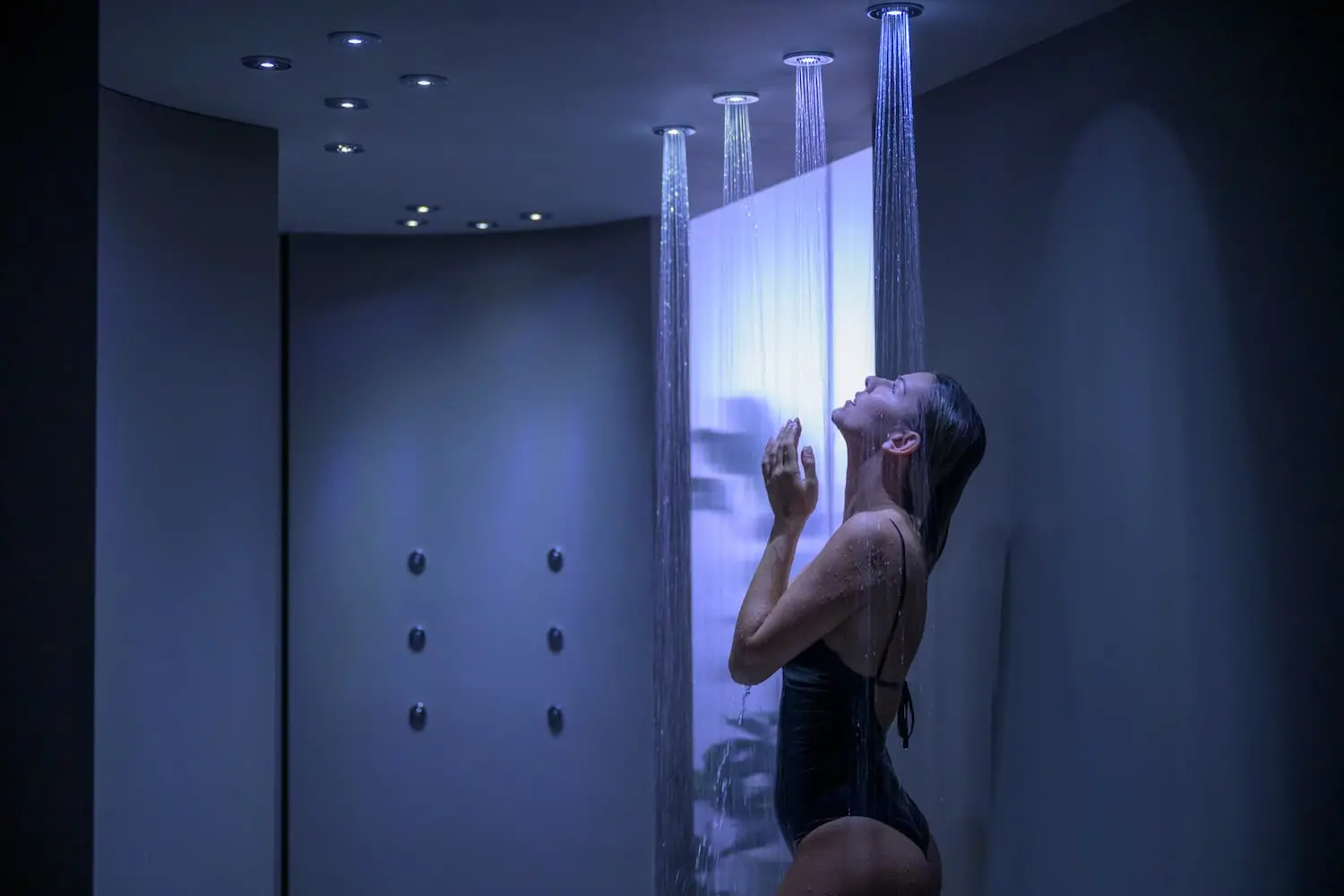
The pool is adjoined by a contrasting wellness area. At Al Nino, this consists of a ZIEGRA ZBE 250 flake ice machine with a daily capacity of up to 250 kg and Aquaform experience showers. Fairmont complements the pool with three TAO Conti designer saunas, a TAO Indi steam cabin and a Ziegra ice maker. Swimming outside into the cold air thus becomes part of the sauna cycle.
Conclusion
An interconnected indoor and outdoor pool is a technically demanding feature, the quality of which depends on the interplay of details: thermal insulation, condensation, frost protection, waterproofing and overflow. None of these problems can be solved subsequently, as they are interrelated.
The projects at Al Nino, Damelis and Fairmont share a common principle, but have different layouts, ratios of the two zones and covering solutions. Each of them was created in response to a specific location, climate and operation.
IMAGINOX designs, manufactures and implements such projects from the study stage to servicing, including the integrated management of the entire wellness facility. For more information about projects and consultation options, please visit www.imaginox.com