



When ordinary stainless steel is not enough: how to design swimming pools for demanding chemical environments
In the swimming pool industry, stainless steel has a reputation as a material that can withstand anything. This is largely true in a typical swimming pool with fresh water and standard chemicals. However, there are facilities where the same steel begins to fail within a few years, sometimes even months. A typical example is a pool with a high concentration of salt, such as a floating bath, where the body floats effortlessly on the surface.
Stainless steel is not a single material; it is a whole family of alloys with very different levels of resistance. This article shows how the correct grade of steel is selected, what chlorides do to its surface and why welds, design details, water temperature and maintenance also determine the service life of a swimming pool. We use the floating pool at the Hotel Bedřiška in Špindlerův Mlýn as a technical example.
Why can’t the same stainless steel be used for every pool?
Stainless steel does not corrode thanks to a thin, imperceptible layer of chromium oxide on the surface. This forms spontaneously in contact with oxygen and is restored when scratched. However, this only works if the environment does not damage this layer faster than it can regenerate.
The biggest enemy of the passive layer is chlorides. Technical literature describes pitting corrosion as a localised breakdown of the passive layer by an electrolyte rich in chlorides. Resistance to it is usually assessed by the PREN number, which is based on the formula %Cr + 3.3 × %Mo + 16 × %N and shows how significantly chromium, molybdenum and nitrogen contribute to resistance.
In practice, this means that:
In fresh water with normal pool chemistry, standard austenitic steel 316L (1.4404) is sufficient. It is a proven material for most swimming pools and hot tubs.
In seawater or saltwater with a high chloride content, the same steel may no longer be able to withstand the conditions. Chlorides concentrate in droplets, on the surface and in crevices and gradually penetrate the passive layer.
Therefore, it cannot be said that “stainless steel is stainless steel”. Each pool requires a material decision based on what kind of water will be in it, how warm it will be and how long it will be there.
Stainless steel material grades: from 304 to super duplex
Austenitic steels 304 and 316L. 304 steel (1.4301, or 1.4307 in the low-carbon variant) is not suitable for swimming pool water because it does not contain molybdenum. 316L steel (1.4404) with molybdenum is the standard in pool construction. The PREN of grade 1.4404 ranges approximately from 23 to 28.5, while for duplex steel 1.4462 it is 31 to 38. Steels with a PREN above 32 are generally considered to be resistant to seawater.
Lean duplex. These are “lean” duplex steels (e.g. 1.4162 or 1.4062) with a lower alloy content. Their PREN is approximately 26, i.e. similar to that of 316L, but they have approximately twice the yield strength. They are suitable where strength is concerned, and less so where chloride resistance is concerned.
Standard duplex 2205 (1.4462). It has a two-phase structure (austenite + ferrite) and contains more chromium, molybdenum and nitrogen. For marine environments and environments with high chloride levels, this is the first sensible step up from 316L. In comparative tests in seawater, the ranking of resistance to localised corrosion was as follows: 1.4404 is the weakest, 1.4462 is significantly better, and super duplex 1.4410, together with other highly alloyed grades, is the highest.
Super duplex (1.4410) and highly alloyed austenites (6Mo, 904L). They are designed for the most demanding environments. 904L steel has a PREN of at least 34 and is designed to resist both pitting and crevice corrosion in the presence of chlorides. In one laboratory study with an extremely aggressive environment (dilute sulphuric acid with sodium chloride at 90 °C), duplex grades 1.4662 and 1.4462 were susceptible to pitting corrosion, while grades 1.4547 (PREN 43) and 1.4410 (PREN 44) resisted under all conditions monitored. The conditions in the study are harsher than in a swimming pool. However, it shows that there is another level of resistance above that of conventional duplexes.
A higher grade is not automatically a better choice. It is more expensive, more difficult to process and weld, and its advantage is not utilised in fresh water. The correct procedure is to select the grade exactly according to the load.

What chlorides do and why saltwater pools are special
Chlorides cause three types of damage that the designer must deal with.
Pitting corrosion. Small pits form on an otherwise smooth surface. They are inconspicuous to the eye, but they spread inside and can pass through the entire thickness of the sheet.
Crevice corrosion. It occurs where there is a narrow gap between two surfaces in which water stagnates. Chlorides accumulate there and the environment becomes acidified. Crevice corrosion often starts at a significantly lower chloride concentration than pitting corrosion. Experiments with chlorinated water have confirmed that the presence of a crevice increases the risk of localised corrosion. Even higher grades are not immune: when harsh conditions (seal pressure, surface roughness, low water temperature) are combined, even duplex 1.4462 or super duplex 1.4410 can be exposed to crevice corrosion. Design details are therefore just as important as the choice of steel.
Concentration by evaporation. This is the main risk of saltwater pools. The water evaporates and the salt remains. On the walls above the surface, on the edges, in the spray and on the condensate, salt layers dry with a much higher concentration of chlorides than in the water. These areas often corrode before the tank itself.
Salt is not like salt
Magnesium sulphate (Epsom salt) is most commonly used in conventional floatation cabins. On the other hand, chloride-based salts are also used for environments inspired by the Dead Sea. Sulphate is milder than chloride in terms of pitting corrosion, so the exact composition of the salt mixture is crucial for the choice of steel. When designing, we therefore always ask the salt supplier for the chemical composition and the maximum expected chloride concentration.
In addition, the high density of the water (about a quarter higher than that of fresh water) also means a greater hydrostatic load on the walls and the floor. The structural integrity of the tank must take this density into account.
Water temperature: why 37 °C plays a role
Resistance to pitting corrosion depends significantly on temperature. It also indicates the critical pitting temperature (CPT), i.e. the temperature above which pitting begins to form on the material in question. For 1.4404 steel, the CPT in laboratory tests ranges between 24 and 27.5 °C, and for 1.4462 duplex steel between 27.5 and 34.5 °C.
CPT values are laboratory comparative figures obtained under defined conditions. They do not directly predict what will happen in a particular pool. However, they do show one crucial thing: the warmer the water, the narrower the safety margin. The floatation bath is kept at body temperature, approximately 37 °C. Chlorides are formed in large quantities, and the warm environment accelerates evaporation. For such an operation, therefore, steel that would withstand temperature-neutral water is not sufficient.
Design details: where service life is determined
Correctly selected steel will only help if the structure does not create areas where the corrosive environment is concentrated.
No blind spots or crevices. All joints, bushings, flanges and attachments of nozzles or luminaires must be designed so that water does not stand in them permanently. Sheet metal overlaps and covered gaps are among the highest-risk areas. Joints should be addressed by welding into a single unit, not by overlapping and sealing.
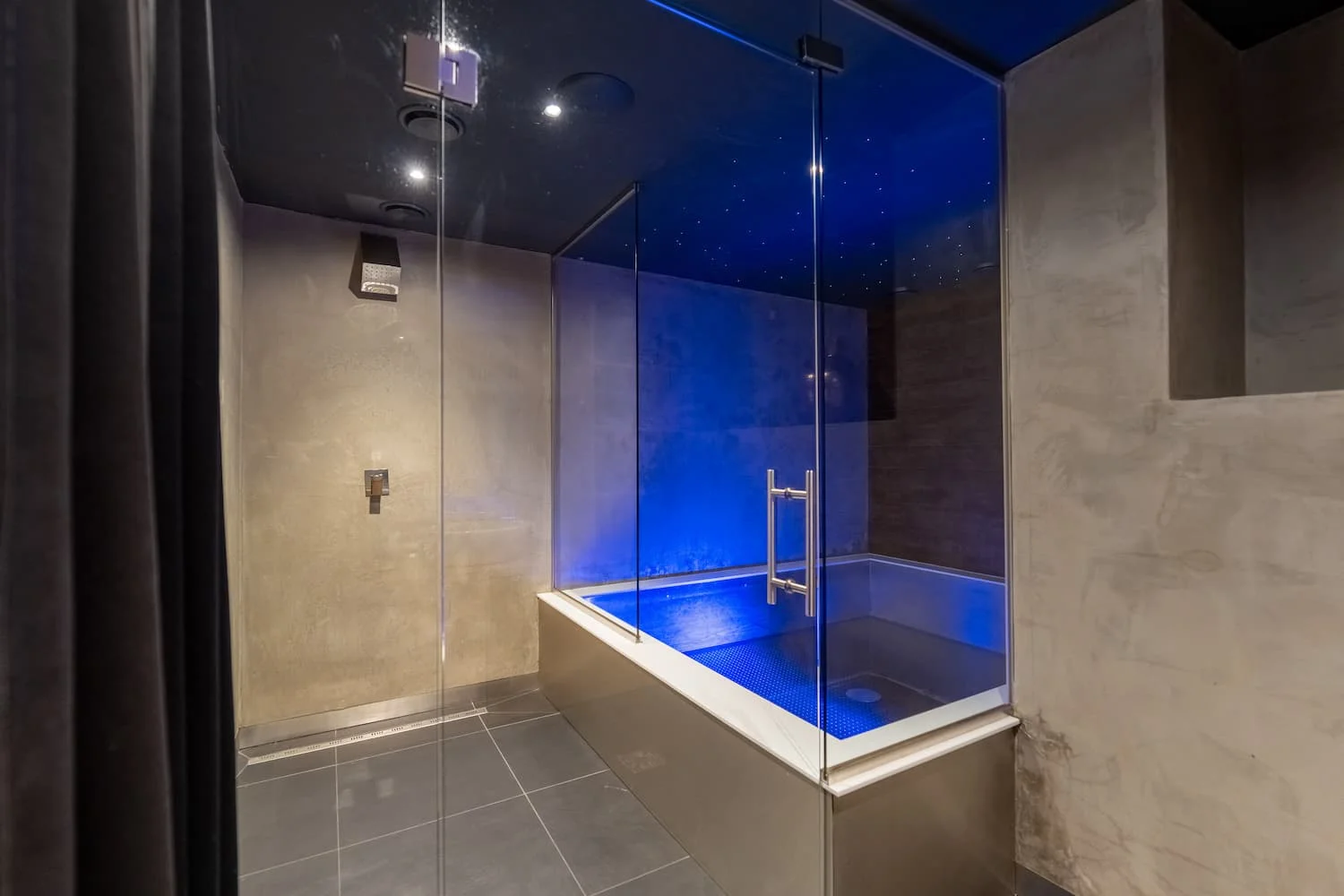
Complete emptying and drainage. The bottom must be sloping towards the drain so that the pool can be drained, rinsed and no salt sediments remain in it. The photo from Bedřiška shows a drain integrated directly into the bottom of the pool.
Surface and anti-slip. A smooth surface is easier to clean and less salt accumulates on it. The anti-slip dimpling, which can also be seen on the bottom of the floatation tank in Bedřiška, should be designed so that salt residues do not settle in the indentations and can be rinsed out completely.
Protection against iron contamination. During production, stainless steel must not come into contact with carbon steel. Carbon steel wire brushes introduce iron particles into the surface, which then cause rust stains, so only stainless steel tools are used. This is often forgotten during production.
Environment above the surface. The floatation room is enclosed, warm and humid, and contains a salt aerosol. Therefore, even parts that do not come into contact with water are subjected to stress: hinges and handles on glass walls, brackets, light fittings and frames. The stainless steel handle on the entrance door, which can be seen in the photo, must withstand the same environment as the pool.
Welds: the place where stainless steel fails most often
The weld and its surroundings are the most vulnerable area of any stainless steel structure. The heat during welding changes the structure of the material and oxides form on the surface.
Heat tint. During welding, the area around the weld is heated to over 1000 °C and, when oxygen is present, oxides, known as heat tints, form on it, which can significantly reduce corrosion resistance. It is recommended to remove them, and the most effective way to do so is by pickling, after which the resistance is comparable to that of the base material. A light straw colour indicates a weak oxide, while blue, purple and grey indicate a heavily damaged layer.
Sensitisation. If austenitic steel remains in the temperature range of approximately 450 to 850 °C for a long time, chromium carbides precipitate at the grain boundaries and the surrounding metal becomes depleted of chromium. In response to this, low-carbon grades 304L and 316L with a carbon content of up to 0.030% were developed. For this reason, only the “L” variant is used for welded pool structures.
Filler materials and protection of the weld root. The welding wire must correspond to the base material: ER316L is used for 316L, which adds molybdenum to the weld for the same resistance to pitting corrosion, and ER2209 for duplex 2205. Duplex steels are usually welded with filler metal, while conventional austenites can often be welded without it, and superalloy filler materials are used. Protection of the weld root with an inert gas is also essential. Welding without protection of the root side leads to severe oxidation, which cannot be completely remedied by any subsequent treatment.
Weld finishing. The standard procedure is pickling followed by passivation, which restores the protective layer of chromium oxide. For critical applications, the combination of pickling and electropolishing provides the highest resistance. Pickling is demanding in terms of both technology and safety, as aggressive acids are used. That is why, in high-quality operations, it is handled by specialists, not “somehow” in-house.
In the case of pools that we weld on site, these principles must also be observed in the confined space of the construction site, where conditions are worse than in the production hall.
Maintenance: how to protect the pool after handover
A properly designed pool still needs care that is appropriate for the aggressive environment.
Regular rinsing of surfaces above the water level with clean water to prevent salt crusts from building up on them.
Monitoring of water composition, especially chloride concentration, pH and disinfection. Chemical management should be set according to operation, not according to a standard pool.
Stainless steel tools and suitable cleaning agents. Aggressive cleaners containing chlorides must not be allowed to dry on the surface.
Regular inspections of welds, gaps and grommets. Minor corrosion detected early can be treated, but advanced corrosion cannot.
Removal of deposits and residues while they are soft. Ideal conditions for localised corrosion are created underneath them.
Example from practice: floating pool at Hotel Bedřiška
The floating pool at the Bedřiška Hotel in Špindlerův Mlýn is a model example of this topic. This is a special stainless steel pool designed for floating, i.e. relaxation consisting of floating the body in water with an exceptionally high concentration of salts and minerals. The water has a temperature of approximately 37 °C and its density mimics the environment of the Dead Sea.
The photograph shows several details that we wrote about above:
the pool has an integrated drain in the bottom and a dimpled bottom, which also serves as an anti-slip treatment.
the shell of the pool and the surrounding structure are designed as a whole without unnecessary joints.
the space is enclosed by a glass wall with stainless steel handrails, so the environment of moist, saline aerosol affects all elements of the structure.
the atmosphere is completed by blue LED lighting and a ceiling with fibre optics that simulate a starry sky.
The hotel’s wellness complex was built ten years ago and, according to the hotel’s reference, all IMAGINOX products are still in excellent condition after ten years of intensive use. The floating pool shows how important expertise in stainless steel and an individual approach to each project are. This is because ordinary steel for standard swimming pools may not be sufficiently resistant for such an aggressive environment.
Conclusion
Stainless steel is an extremely durable material, but only when it is treated as a material with clearly defined limits. 316L steel is ideal for most pools. However, as soon as high concentrations of chlorides, elevated temperatures and an enclosed, humid environment come into play, one must look higher: a suitable steel grade, flawless welds, a crevice-free design and well-thought-out maintenance.
IMAGINOX designs and manufactures stainless steel pools even for environments with extreme demands on materials. Each project begins with an analysis of the operating conditions, because the right material is selected according to the load, not according to the catalogue. For more information and reference projects, please visit www.imaginox.com


