Infrared sauna: how it works and who it helps
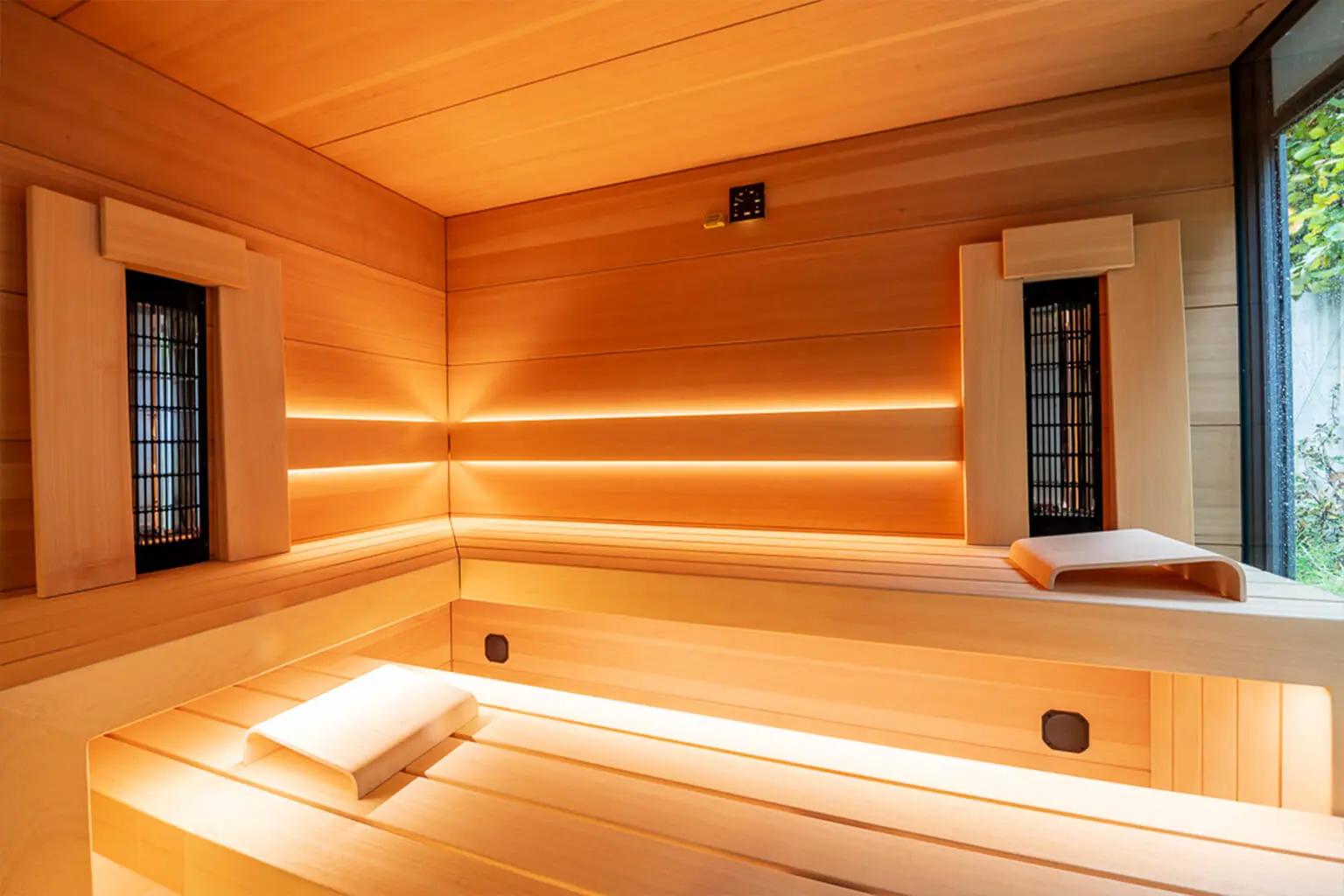
The classic Finnish sauna isn’t for everyone. Ninety degrees, hot air, the feeling that you can’t breathe – some people love it, others simply hate it. And then there’s the infrared sauna: a different principle, lower temperatures, an equally deep effect. For some people, it’s even more effective than the classic sauna.
How an infrared sauna works – and why it’s not UV radiation
An infrared sauna does not use hot air, but infrared radiation. This penetrates the skin to a depth of about three centimetres and heats the body directly – from the inside out, not from the outside in as in a classic sauna. The result is more intense sweating at a significantly lower temperature: the infrared sauna typically operates in the range of 45–60 °C, where you won’t even start sweating in a classic Finnish sauna.
One of the most common concerns? Confusing infrared radiation with UV radiation. They are two completely different things. UV radiation (the one that causes sunburn) can damage the skin and eyes in high doses. Infrared radiation is a natural form of thermal radiation – the same that is emitted by the sun or the human body. It is safe and beneficial for the body.
What an infrared sauna does to the body
The sweat produced in an infrared sauna contains up to 20% toxins, while in a classic Finnish sauna it is 5–7%. This makes it a significantly more effective detoxification tool. During infrared radiation, the body excretes harmful substances that it otherwise stores in adipose tissue – beyond the reach of normal sweating.
Another documented benefit is the effect on blood circulation: infrared radiation causes blood vessels to dilate and increases blood flow, which has a direct impact on healing, reducing inflammation and relieving pain. This is where the popularity of the infrared sauna among people with arthritis, eczema, psoriasis or chronic back pain comes from.
A complete overview of proven benefits includes boosting immunity, supporting the heart and blood circulation, relieving muscle and joint pain, improving skin quality, helping with cellulite, reducing stress and improving sleep quality.
Who is an infrared sauna particularly suitable for?
An infrared sauna is the first choice for people who can’t stand the hot air of a classic sauna – but want its benefits. The lower temperature also makes it more accessible for seniors and people with cardiovascular problems, for whom a classic sauna is unsuitable or too risky.
On the other hand, people who are hypersensitive to heat in general should be careful – symptoms such as palpitations, dizziness, nausea or difficulty breathing are a sign that an infrared sauna is not the right choice. Pregnant women should consult a doctor before use.

How to use an infrared sauna correctly
Before entering, set the temperature to maximum – the infrared panels will then work at full power the whole time and you will absorb the maximum amount of radiation. At a lower setting, the heaters switch off and on continuously, reducing efficiency.
The basic protocol is as follows: shower before entering, dry off, then 10–20 minutes in the sauna. For regular sauna use, three cycles of 10 minutes are recommended, with rest breaks of at least the same length. The ideal frequency is two to three times a week. The best time to use the sauna is in the morning – warm up, sweat, drink a glass of water and start the day with energy.
Fluids are key: on the day of the sauna, drink about three litres, half a litre before entering. You sweat significantly more in an infrared sauna than in a classic sauna – fluid loss reaches up to 2% of the total body content, which is not negligible.
Practical benefits of a home infrared sauna
Of all types of saunas, the infrared sauna is the simplest in terms of logistics. It does not require a special floor, water supply or increased electrical protection – a standard 230 V socket is sufficient. The power consumption is comparable to that of a steam iron. It comes as a prefabricated cabin that you assemble at home like a flatpack cabinet and move whenever you need to.
This makes it significantly different from a classic sauna, which is usually custom-built and difficult to move. If you are looking for a wellness element that will fit into your flat, bedroom, terrace or basement without any building work, an infrared sauna is the obvious choice.
How to enhance your experience
The infrared sauna combines perfectly with aromatherapy: bowls with essential oils or a diffuser placed in the cabin will take your senses in a different direction and deepen your relaxation. At the end of each cycle, try a peel – open pores after warming up absorb active ingredients significantly better than under normal conditions.
Many models are equipped with chromotherapy – light therapy in different colours of the spectrum. Warm colours (yellow, orange, red) stimulate and activate, while cold colours (blue, turquoise, purple) calm and induce relaxation. One cycle, one colour – simple and surprisingly effective.
The infrared sauna is just one of many elements that can be included in home wellness. If you are considering a more comprehensive solution – with a whirlpool, cooling pool or designer sauna – take a look at the projects at www.imaginox.com. We tailor each project so that the products function as a whole, not as a randomly assembled set.
You may be interested
A sauna or a hot tub after a workout? Both work – but in different ways and at different times

A stainless steel rooftop swimming pool: why metal is the best material when every kilogram counts