Covered swimming pools: why they’re worth it and which types of cover to choose
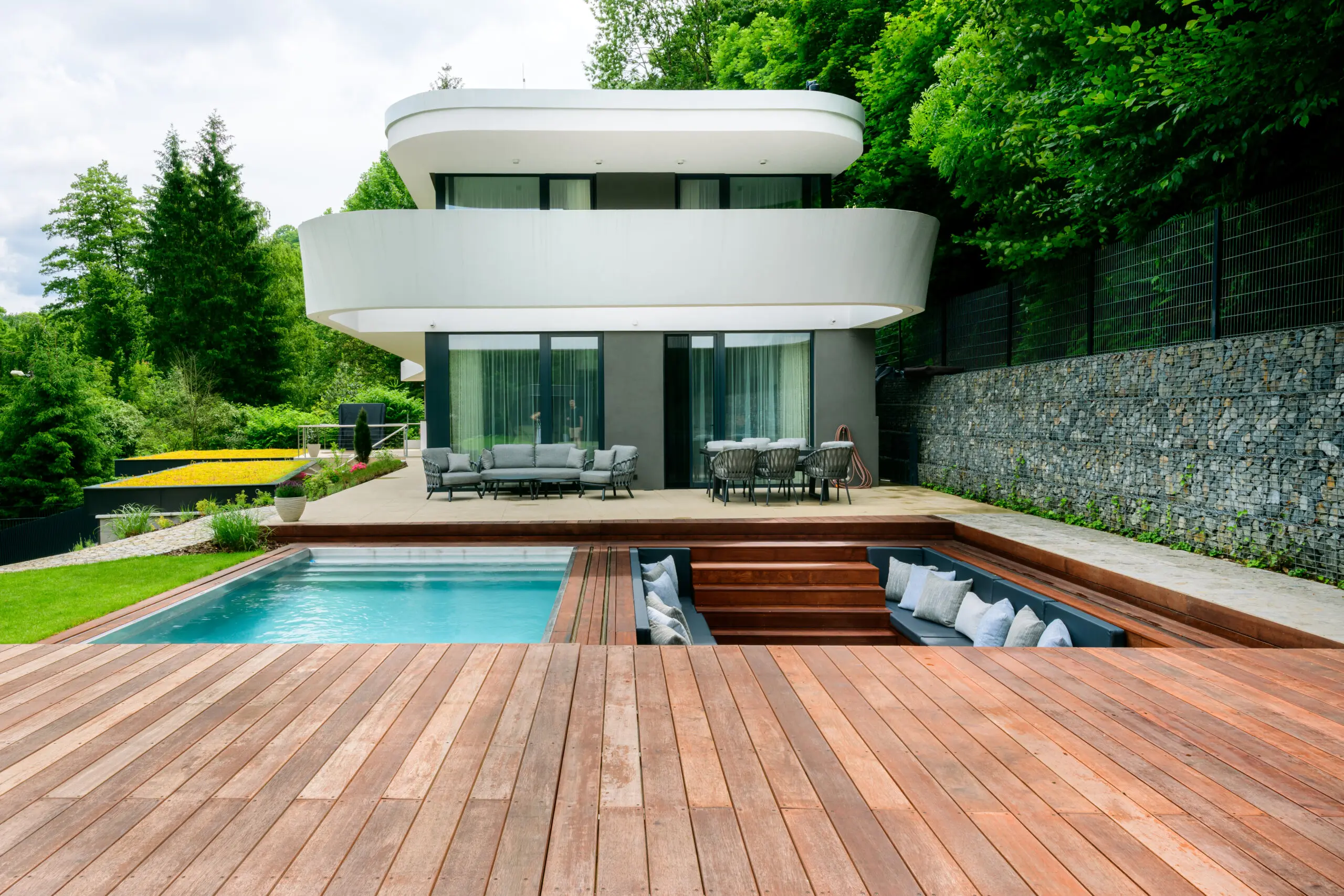
Today, swimming pools with enclosures represent a standard that goes far beyond protecting the water from leaves. At the same time, the general public imagines various things when they hear the term “enclosure” – from classic sliding domes to automatic slatted covers to technologically advanced sliding floors that literally turn the pool into a terrace. All these solutions have a common goal: to extend the swimming season, reduce operating costs and increase the safety and comfort of using the pool.
In our climate, it is possible to swim in an uncovered pool for about three months of the year. However, enclosed pools extend this period to six months or more. Let’s take a look at why enclosures are worthwhile and what types of solutions the market offers.
Why choose an enclosed swimming pool
Enclosed pools offer a number of specific benefits that are evident in day-to-day operation:
Longer swimming season
The enclosure creates a greenhouse effect – the sun’s rays penetrate the polycarbonate panels and heat the water and air under the enclosure. At night and on cloudy days, the water cools down more slowly. The swimming season is thus extended from early spring to late autumn, in some cases up to nine months of the year.
Warmer water
Thanks to the greenhouse effect and the thermal insulation of the enclosure, the water is heated naturally by sunlight, while its cooling at night is slowed down. With a slatted cover with solar slats, the water temperature can be increased by up to 5°C compared to an uncovered pool.
Cleaner water and less maintenance
The enclosure prevents leaves, dust, pollen and insects from falling into the pool. Filtration works more efficiently, the consumption of pool chemicals is reduced and the owner saves time that would otherwise be spent cleaning the surface.
Lower operating costs
Covering the pool significantly reduces heat loss through evaporation – up to 90% of heat loss from the water is caused by heat escaping through the uncovered surface. Slatted covers reduce water heating costs by up to 60% and reduce the consumption of chemical products. In addition, in the case of indoor pools, it reduces the evaporation of moisture into the surrounding air, thereby reducing the load on dehumidifiers.
Safety of children and pets
Both enclosures and fixed slatted covers act as a barrier against children and animals accidentally falling into the water. Sliding enclosures can be locked with a key, the slats can bear loads thanks to their design and hermetically sealed chambers, and the systems comply with European safety standards.
Weather protection
The enclosure allows you to swim even in rain, wind or lower temperatures. On hot summer days, the segments can be pushed aside and the pool can be used in the open air.

Classic retractable pool enclosure
Retractable enclosures are the best-known and most common type of pool enclosure in our country. It is swimming pools with enclosures of this type that make up the majority of installations on the Czech market. It consists of individual segments that move along rails on both sides of the pool. The structure is made of aluminium profiles, and the infill consists of polycarbonate sheets – either hollow (with better thermal insulation) or solid compact (with better transparency).
Retractable enclosures are divided according to height:
Low enclosure
An unobtrusive solution that does not obstruct the view of the garden. The pool is protected from dirt and the weather, and you can swim in it, but you cannot stand up after getting out of the water. Suitable for smaller gardens and compact spaces. Some models can also be installed without rails, allowing barrier-free access to the pool.
Medium-height enclosure
The golden mean between low and high enclosures. It combines the advantages of both types – it offers more space than the low variants, but is not as prominent a feature in the garden as a high enclosure.
High (walk-in) enclosure
It offers the comfort of free movement throughout the entire area. An adult can stand upright, walk and sit. Sun loungers, garden furniture and a hot tub can be placed under the enclosure. It creates a space for sitting with family and friends, regardless of the weather. The tallest types create a habitable enclosed terrace.
Advantages and disadvantages of retractable enclosures
The main advantages include an extended season, the possibility of swimming in bad weather, high security (locking) and flexibility in terms of shapes and sizes. Swimming pools with sliding enclosures are therefore a popular choice for family gardens. The disadvantage is a more pronounced visual impact on the garden, especially with tall variants. For proper functioning, the precise flatness of the substrate is important – the tolerance should not exceed 2 mm per 1 m of length.
Slatted pool cover
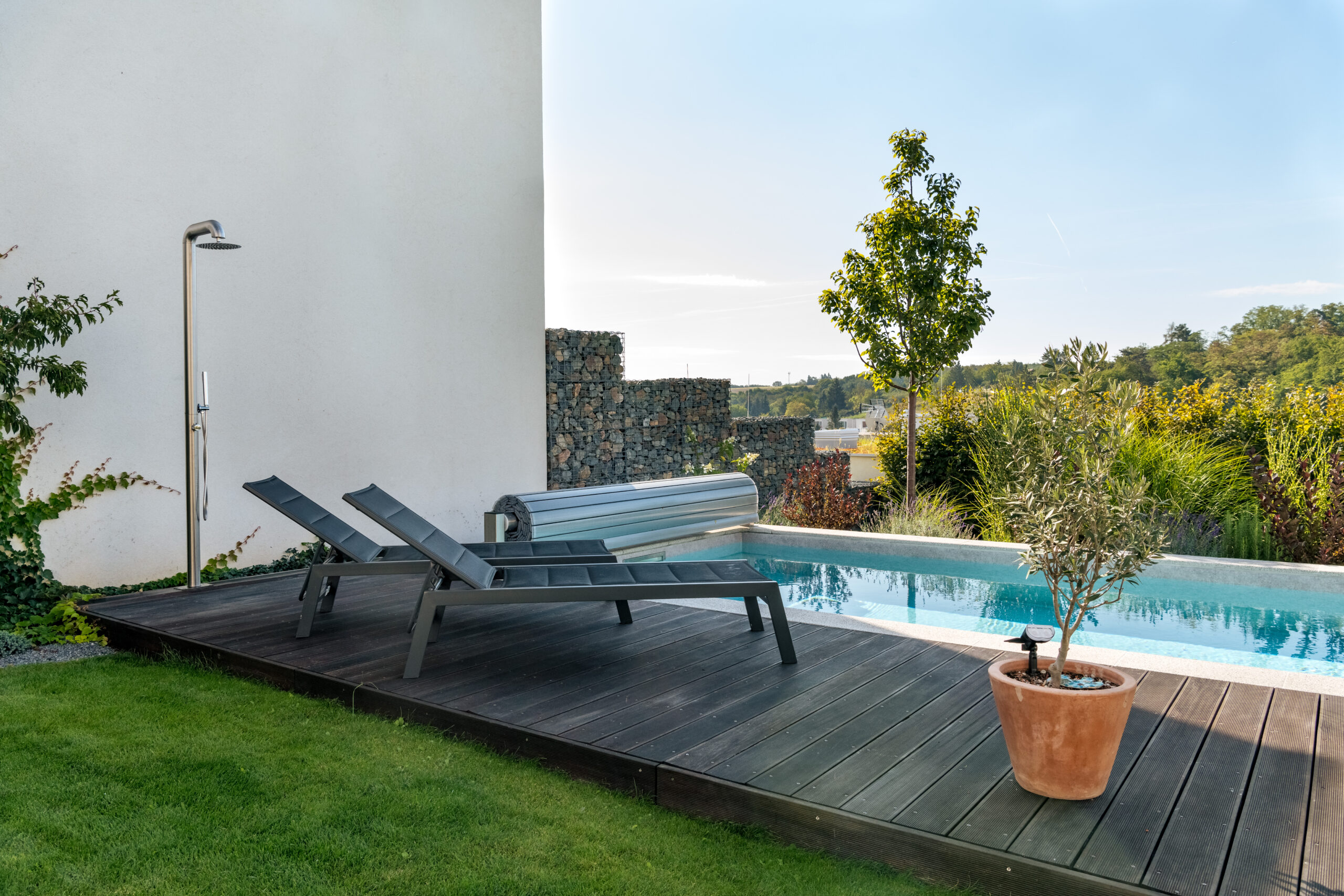
Slatted covers represent a modern, discreet and stylish alternative to traditional enclosures. Although it is not an enclosure in the true sense of the word, pools with enclosures and slat covers share a common goal – to protect the water and extend the season. It works on the principle of floating slats – hermetically sealed hollow profiles made of PVC or polycarbonate, which, when joined together, form a floating shutter that perfectly covers the water surface of the pool.


How it works
The slats float on the surface of the water without the need for guide rails, rods or ropes. Retraction is provided by an electric motor that can be operated by a remote control, a conventional switch or connected to a smart home system. At the press of a button, the pool is uncovered and ready for use; at the next press, it is covered and safe.
Above-water vs. below-water installation
- Above-water design – The winding rod is positioned above the water level at the edge of the pool. It can also be retrofitted to existing pools. A simpler and more affordable option.
- Sub-surface (underwater) design – The winding mechanism is concealed below the surface in the pool structure – in the floor, wall or under the relaxation bench. The shutter cover does not detract from the appearance or obstruct walking around the pool. It meets the most demanding design and aesthetic requirements. Sub-surface installation can also be carried out in already completed pools using an underwater motor.
Types of slats
The slats are manufactured in two basic materials:
- PVC slats – Three-chamber profiles with UV stabilisation, available in eight or more colours. Weather-resistant.
- Polycarbonate slats – Highly durable profiles with a longer service life, also available in solar versions. Resistant to hail up to 30 mm in diameter. They have better insulation properties – the premium 67.5 × 16.5 mm profile achieves a U-value of 3.80 W/m²K.
- Solar slats – Special slats with a transparent top layer that creates a greenhouse effect. The black underside captures the sun’s rays and heats the water. When used, there may be no need to install solar collectors or a heat pump.
- Transparent slats – They preserve the visual effect of the water surface and create an exclusive look, especially at night when the underwater lighting is switched on.
Main benefits of slatted covers
- Discreet appearance – Compared to sliding enclosures, slatted covers are practically invisible from a distance and do not detract from the appearance of the garden.
- Thermal insulation – The slats form an impenetrable insulation of the water surface, reducing heat loss and water evaporation.
- Cleaner water – The cover prevents photosynthesis, which causes the formation of algae. It reduces the consumption of chemicals.
- Convenient operation – Automatic cover via remote control or app.
- Safety – Rigid slats that meet safety standards prevent children and animals from falling into the water.
Limitations
As standard, slatted covers can only be used on rectangular-shaped pools. For some types, care must be taken with regard to safety limits – not every slat is designed to bear the weight of an adult. It is always necessary to verify that a particular system complies with the relevant safety standards.
Sliding pool floor
The sliding (lifting) floor represents the absolute pinnacle in the field of pool covers. This is not an enclosure in the traditional sense of the word, but a technologically advanced system that literally transforms pools with or without an enclosure into a walkable area – a terrace, seating area or living space.

Operating principle
The moving floor functions as a hydraulic platform installed in the pool. When the floor is raised, the water naturally overflows underneath it and the floor completely covers the water surface. When it is lowered, the water is pushed back up to the surface of the floor by pressure. The hydraulic mechanism is concealed in the walls of the pool and under the floor, so it cannot be seen.
The moving floor structure is made of 316L stainless steel, which ensures strength and durability. The load-bearing capacity of the covered pool is up to 200 kg/m², which allows for normal use of the area as part of a terrace or interior.
Adjustable water depth
One of the biggest advantages of a movable floor is the possibility of smoothly adjusting the pool to any depth:
-Full depth – For swimming and recreational bathing by adults.
-Shallow water – For a children’s paddling pool and safe play for children.
-Intermediate position – For rehabilitation, water aerobics or relaxation.
-Completely closed – The floor is at the level of the surrounding floor, the pool disappears and the area serves as a terrace.
The floor can be stopped in any position and controlled from the wall panel, with an individual code or via a mobile app that allows three depth settings to be saved.

Who is the movable floor suitable for?
The movable floor is a premium solution that is particularly suitable for:
–Luxury residences – Where the pool is part of the interior or terrace and the space needs to be used in a multifunctional way.
-Small gardens – Where there is not enough space for the pool to occupy the area all year round. The movable floor allows the same area to be used both as a swimming pool and as a terrace.
-Wellness centres and hotels – Where there is a need to flexibly change the depth for different types of visitors and activities
-Interiors – The floor, lined with the same material as the surrounding floor, completely disappears from view when covered
A movable terrace as an alternative
A less expensive option than a vertically movable floor is a horizontally movable terrace. This closes the pool at floor level and creates space for garden furniture. It moves on rails, can be equipped with an automated drive with remote control and manual control, and is secured with brakes and locks. The load-bearing capacity of the sliding terrace is up to 150 kg/m².

Other covering options
In addition to the three main types – sliding enclosures, slatted covers and sliding floors – there are a number of other solutions that may be suitable for specific situations. Enclosed pools offer a wide range of options beyond these main categories:
Solar cover (bubble wrap)
The simplest and most affordable way to cover a pool. The cover floating on the surface uses sunlight to heat the water and reduces evaporation. However, handling it is inconvenient – it has to be pulled on and off manually, it is easily damaged and can be lifted by the wind. It is suitable as a basic solution for smaller pools.
Safety cover
A rigid cover stretched over the surface, which primarily serves a safety function – it prevents children and animals from falling into the pool. Some variants can be anchored to the pool coping.
Winter cover
Used to protect the pool out of season. It covers the surface and protects the water from dirt and UV radiation and separates the slats during winterisation.
Portable (mobile) enclosure
Lightweight aluminium structure coated with durable PVC fabric. It is easy to fold and unfold, and can be moved and used elsewhere than by the pool. Suitable for above-ground pools and cottages. However, it does not have the thermal insulation properties of a fixed enclosure and is not a year-round solution.
How to choose the right enclosure or cover
Choosing the right solution depends on several factors:
| Criterion | The question to ask yourself |
| Type of pool | New or existing? Rectangular or atypical shape? |
| Garden space | Is the enclosure visually acceptable, or should the pool remain discreet? |
| Safety | Are there young children or pets in the family? What level of protection do you need? |
| Ease of operation | Do you want manual operation or automatic remote control? |
| Use of space | Do you just want to cover the pool, or do you want to use the area in a multifunctional way (terrace, seating area)? |
| Budget | The solar cover is the most affordable option, while the movable floor represents the highest investment. |
| Visual requirements | Should the pool remain visible, or should it “disappear” after being covered? |
The fundamental difference between the solutions lies in what happens to the space above the pool. Swimming pools with sliding enclosures retain the space above the water surface for swimming. The slatted cover covers the surface and is invisible from a greater distance. The movable floor fully integrates the pool into the surrounding floor and creates a fully-fledged terrace.
Conclusion
Today, swimming pools with enclosures offer solutions for every situation and every budget – from simple solar covers to automatic slatted covers and sliding polycarbonate enclosures, to technologically advanced movable floors that turn the pool into a terrace. The common denominator of all these solutions is an extended swimming season, cleaner water, lower operating costs and greater safety.
The key recommendation is to address the issue of enclosures or covers at the design stage of the pool. Pools with enclosures and advanced covers require integration into the structure at the design stage – both slatted covers and movable floors are best integrated if they are taken into account from the outset. Submerged storage of the shutter, the concealed hydraulic mechanism of the movable floor and the correct connection to the technology – all of this requires advance planning. A non-binding consultation with a specialist supplier is the best first step towards a pool that will serve you for a long time, safely and with maximum comfort.
You may be interested
A sauna or a hot tub after a workout? Both work – but in different ways and at different times
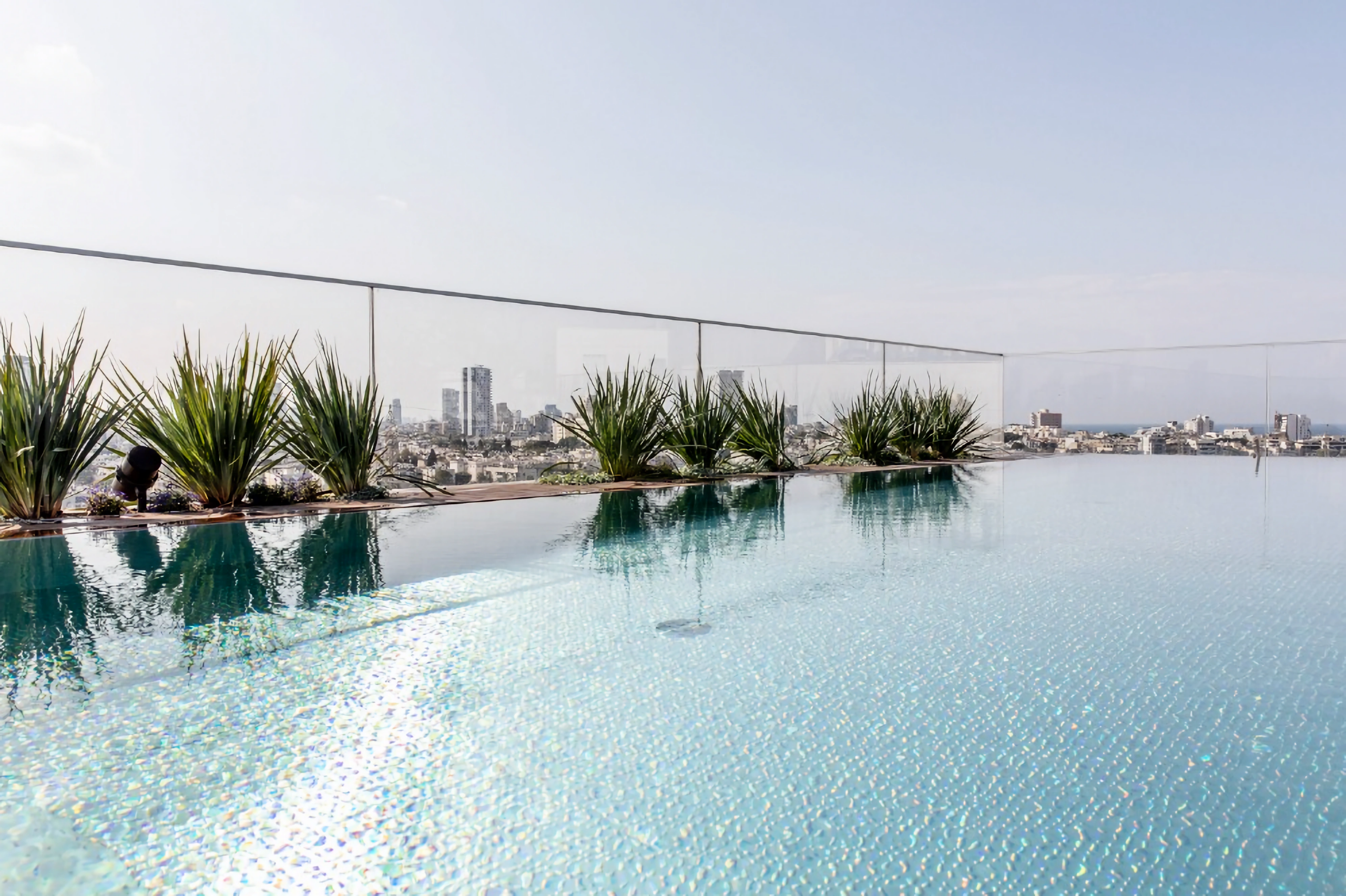
A stainless steel rooftop swimming pool: why metal is the best material when every kilogram counts