Lift-up pool floor for architects: advantages, design options and inspirational implementation
A swimming pool no longer has to be a permanently open body of water that takes up valuable square metres of garden or interior space. The lifting pool floor is an architectural tool that allows one space to serve multiple purposes at the same time – from a swimming pool to a children’s paddling pool to a full-fledged terrace or living space. For architects and designers, this means completely new possibilities for working with water and space in their designs.
Lift-up floor as part of an architectural concept
A traditional pool is a spatially fixed element – either there is water in it or there isn’t, and the pool area remains reserved exclusively for swimming. The lifting pool floor changes this paradigm. During the day, a single space can gradually function as a swimming pool for adults, a shallow relaxation pool, a children’s paddling pool, a terrace for sitting with friends, or even as a social and living space.
The principle is elegantly simple: the system allows the pool depth to be adjusted smoothly using a hydraulic mechanism concealed in the structure. The bottom can be stopped in any position – from a depth of a few centimetres, suitable for the youngest children, to full depth for competitive swimming. When raised to the highest position, the bottom covers the water surface and aligns exactly with the level of the surrounding floor. The result is a barrier-free flat surface on which you can place garden furniture, have a barbecue, practise yoga, or simply use the space to relax.
For architectural design, this means that the pool ceases to be an element that claims exclusive space. Instead, it becomes a multifunctional zone that can adapt to the needs of the residents and the time of day. Swimming in the morning, a playground for children in the afternoon, a terrace for sitting in the evening. This variability is particularly valuable in projects where the size of the plot or interior does not allow for separate zones for each activity.
The concept of the lifting floor thus approaches the idea of flexible living, which resonates more and more strongly in contemporary architecture. Just as sliding walls can redistribute the interior as needed, a lifting pool floor can transform an outdoor or indoor space from a water surface to a solid floor. In the context of luxury residential architecture, where the emphasis is on clean lines and minimal visual distractions, a lifting pool floor is a solution that does not compromise the aesthetic quality of the space, but rather enhances it.

Where a lifting pool floor can be used
The possibilities for using a lifting floor are wide-ranging and, especially in projects with limited space, it brings a new approach to pool design:
- Private villas with a smaller garden – where every square metre is valuable and the pool would otherwise take up too much of the plot.
- Urban residences – the lifting floor allows you to have a pool even on plots where a classic pool would not be feasible due to space constraints.
- Rooftop terraces and apartments – a pool with a lifting floor can function as a rooftop terrace area for sitting when not in use for swimming.
- Indoor pools – in enclosed spaces, the efficient use of space is even more important. The lifting floor allows you to transform the pool hall into a living space.
- Hotel wellness – thanks to the variable depth, wellness centres can offer various programmes in one pool – from a children’s corner to aqua aerobics to swimming training.
- Projects with an emphasis on maximum multifunctionality of space – villas where owners want to maximise the use of every area.
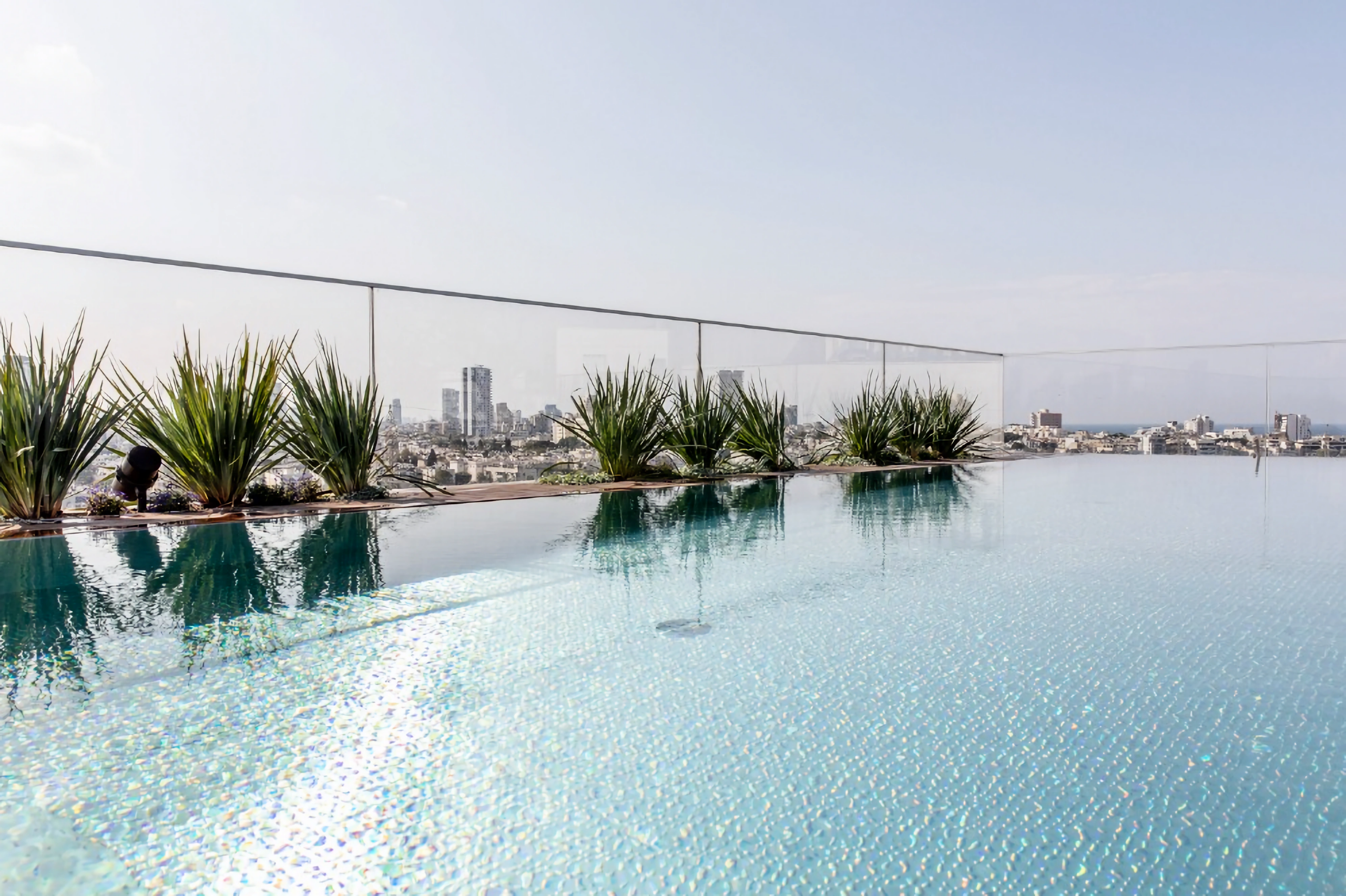
The pool’s lifting floor is also used in projects around the world. IMAGINOX‘s projects include, for example, projects in Madeira and Malta, or a pool with a sliding floor in a skyscraper in Israel. These references show that the system is applicable in a wide variety of climatic conditions and architectural contexts.
Options for integration into a project
For architects, it is crucial that the lifting pool floor can be integrated into a wide variety of projects. The system is adaptable for pools of various sizes, shapes and types – it can be installed in skimmer and overflow pools and in pools of any geometric shape.
Specific integration options include:
- Different depths in individual parts of the pool – the pool can have different depth zones that can be adjusted independently.
- Adaptation to steps and benches – the floor is custom-made according to the parameters of the pool, including the type of steps and any benches.
- Matching the surface of the bottom with the surrounding floor – the cladding of the lifting bottom can be matched with the tiles, stone or other cladding of the surrounding terrace, so that when the pool is closed, the surface visually blends in with the surroundings.
- Connection to a smart home – the system can be connected to a smart home and controlled using a mobile application, in which preset depth levels can be saved.
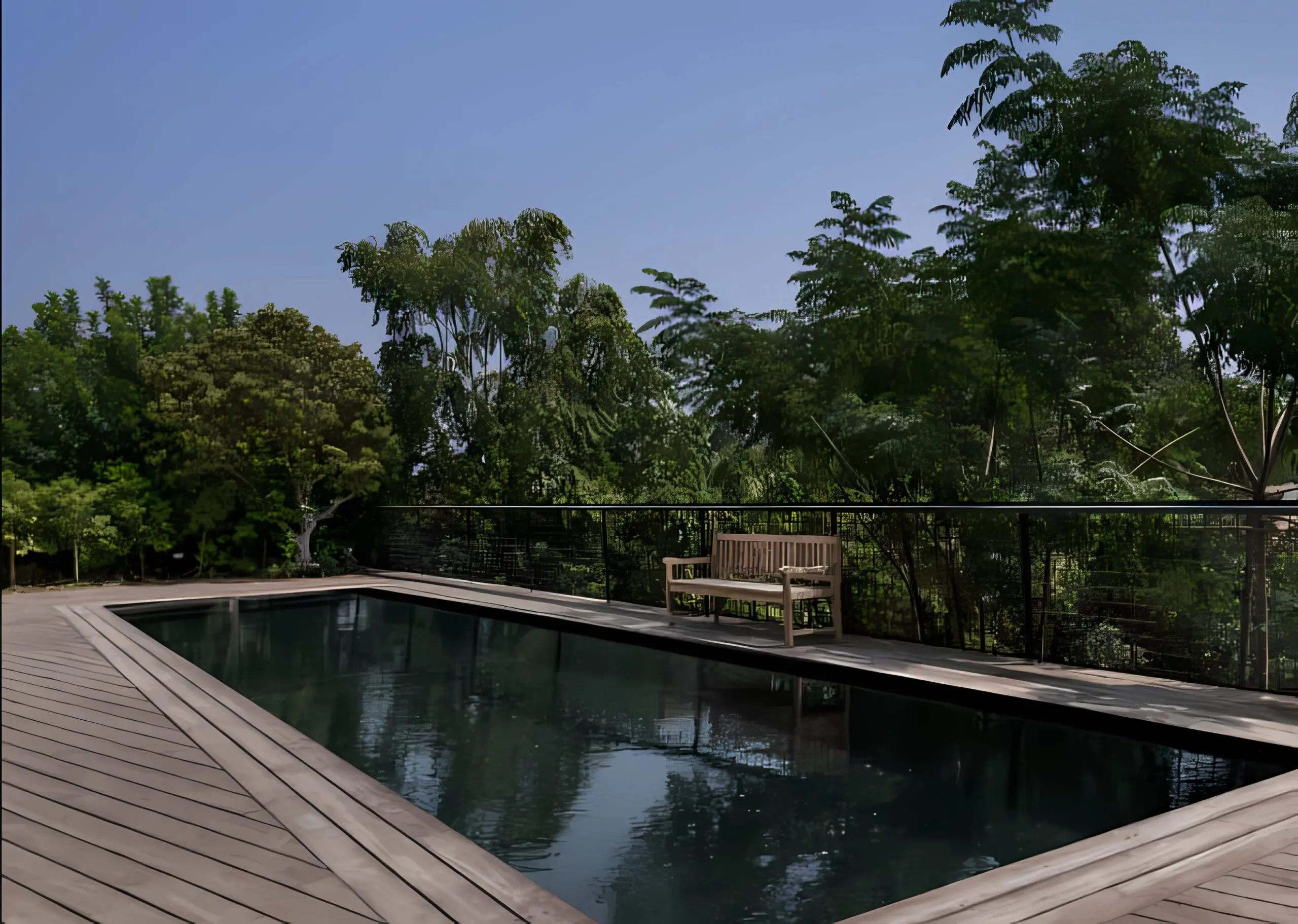
A particularly interesting detail from the point of view of architectural design is the possibility of using not only stone or tiles on the surface of the bottom, but also wood. In the Madeira project, the wooden surface of the bottom visually blends in with the surrounding terrace when the pool is closed, making the pool completely disappear from the visual perception of the space and the transition between the water surface and the terrace seamless. This level of material shows that the lifting pool floor can be perceived not as a technical accessory, but as a fully-fledged part of the surface layer of the architecture – just as important as the choice of paving, wooden flooring or stone cladding.
An important aspect for the design phase is the fact that the system has no demands on the surrounding space – the hydraulic mechanism is completely concealed inside the pool structure and does not require a separate technical space next to the pool. This facilitates integration into existing layouts and reduces the need for structural modifications to the surroundings.

Main advantages of the lifting floor
The lifting pool floor offers a number of advantages that go beyond a conventional pool cover:
- Efficient use of limited space – one space, multiple functions. The pool no longer has to reserve the area exclusively for itself.
- A clean architectural solution without a classic roof – unlike pool roofs, awnings or tarpaulins, the visual impression of the space remains intact.
- Safe covering of the water surface – when fully closed, the floor prevents falling into the pool, which is crucial especially in households with children and pets.
- Variable depth – from a few centimetres for paddling to full depth for swimming.
- Protection of water from impurities – the enclosed pool is protected from leaves, dust and other impurities.
- Reduction of heat loss – closing the pool reduces evaporation and heat loss, which contributes to savings on water heating costs.
- Individual surface solution – the bottom cladding can be matched to the surrounding floor, whether it is stone, tiles or wood.
- Possibility of adding water features – the system allows the integration of counter-current, lighting, massage jets, waterfalls, fountains and other features.
Technical solution
The technology of the lifting floor can be compared to a lift installed in a pool. The movement of the platform is ensured by a hydraulic mechanism concealed in the pool structure, which is completely hidden from view. When the bottom is raised, the water naturally flows under the structure; when it is lowered, on the other hand, it is pushed back above the surface of the bottom by pressure.
Key technical parameters:
- 316L stainless steel construction – a material with high durability and strength, which is the standard for pool chemistry environments. The load-bearing capacity of the covered area is 200 kg/m², which allows normal use of the area as a terrace or living space.
- Fully automated operation – the system does not allow manual manipulation, which increases operational safety. Control is via a wall panel or a mobile application.
- Preset depths – the mobile app allows you to save three different depth levels that can be quickly recalled at any time. The bottom can also be stopped in any position between the minimum and maximum depth.
- Smart home control – the system can be integrated into the smart home control unit and controlled remotely using a mobile application.
- Child tamper protection – the controls can be secured with any code, preventing unauthorised movement of the floor by children.
From the point of view of project preparation, it is important to mention that the lifting floor should be incorporated into the project already at the design stage. The ideal situation is to implement the system during the construction of a new pool, when the structure can be optimally coordinated with other elements. It is also technically possible to convert an existing pool, but the solution is more demanding in this case. Each system is custom-made according to the specific parameters of the pool and the project is always implemented individually.

Inspirational implementation
The presentation of three diverse projects shows how a lifting pool floor can be integrated into different architectural contexts.
Malta: A swimming pool as a terrace above the sea
In Malta, a 10 × 3.5 metre pool with a lifting floor was built. The 316L stainless steel structure, with a declared load-bearing capacity of the covered area of 200 kg/m², allows the area of the covered pool to be used as a fully-fledged terrace. The mobile app allows you to save three different depth levels, so the pool can be quickly adapted to current needs – from a paddling pool for children to a swimming pool for adults. The project shows how a pool with a lifting bottom can maximise the usable area in an environment with limited outdoor space.

Heraklion: Swimming pool on the terrace of a house on a slope
In Heraklion, Crete, a pool with a lifting bottom was integrated into the terrace of a house built on a slope. The project shows the possibilities of individual tiling of the bottom, which can be matched to the surrounding architecture. The equipment includes LED RGB lighting, retractable steps that do not create an obstacle when the pool is closed, a counter-current for swimming training and other water features. The project demonstrates that the lifting floor can be combined with a wide range of additional elements and adapted to demanding terrain conditions.

Madeira: Wood as a connecting element
The project in Madeira represents an unconventional approach to the surface finish of the lifting floor. Instead of stone or paving, wooden cladding was used on the surface of the floor. When the pool is closed, the wooden surface visually blends in with the surrounding terrace, making the pool completely disappear from the perception of the space and the transition between the water surface and the living space is seamless. This project shows how the lifting pool floor can be connected to the architecture of the house and the surrounding landscape through the choice of material.

Conclusion
The lifting pool floor is much more than a luxury element for covering the water. It is an architectural tool that allows for more efficient use of space, unifying surfaces and creating multifunctional zones in villas, urban residences, roof terraces and hotel wellness centres. For architects and designers, it represents a technology that opens up new design possibilities – the pool no longer has to be a spatially fixed element, but can adapt to the needs of users and the time of day. With integration into the smart home, the option of individual tiling and a wide range of additional elements, the lifting pool floor is becoming a natural part of modern architecture.
For architects and designers, this means that it is advisable to consider incorporating a lifting floor into the pool concept at an early stage of the design. The earlier the system is integrated into the project, the better all design, material and operational parameters can be aligned. The result is a pool that is not just a seasonal feature, but a space that can be used all year round and adapted to the needs of users. More at www.imaginox.com